
Bitcoin's Parabolic Arc Snaps: Trader Peter Brandt Eyes $25K Crash Floor

Veteran trader and chart analyst Peter Brandt has warned that bitcoin's BTC$89,583.57 signature growth parabola has fractured, opening the door to a brutal slide potentially down to $25,000.
Brandt's call hinges on exponential decay in bitcoin's bull cycles. The cryptocurrency has historically rallied hard in 12-18 months after halving and subsequently slipped into a bear market, characterized by 70% to 80% pullback from record highs.
However, each bull cycle has seen diminishing returns. For instance, following the first halving on Nov. 28, 2012, BTC chalked out a 100-fold rise to $1,240 by December 2013. The 2016 halving produced a 74-fold rise and the 2020 halving brought an eight-fold rise.
The latest post-halving cycle, which kicked off following the quadrennial event in April 2024, saw prices double to a record high of $126,000 by October this year. Since then, prices have pulled back to just under $90,000, slicing through the parabola curve that has marked massive price uptrends during each prior cycle.
"The current parabolic advance has been violated. 20% of ATH = $25,240," Brandt said on X.
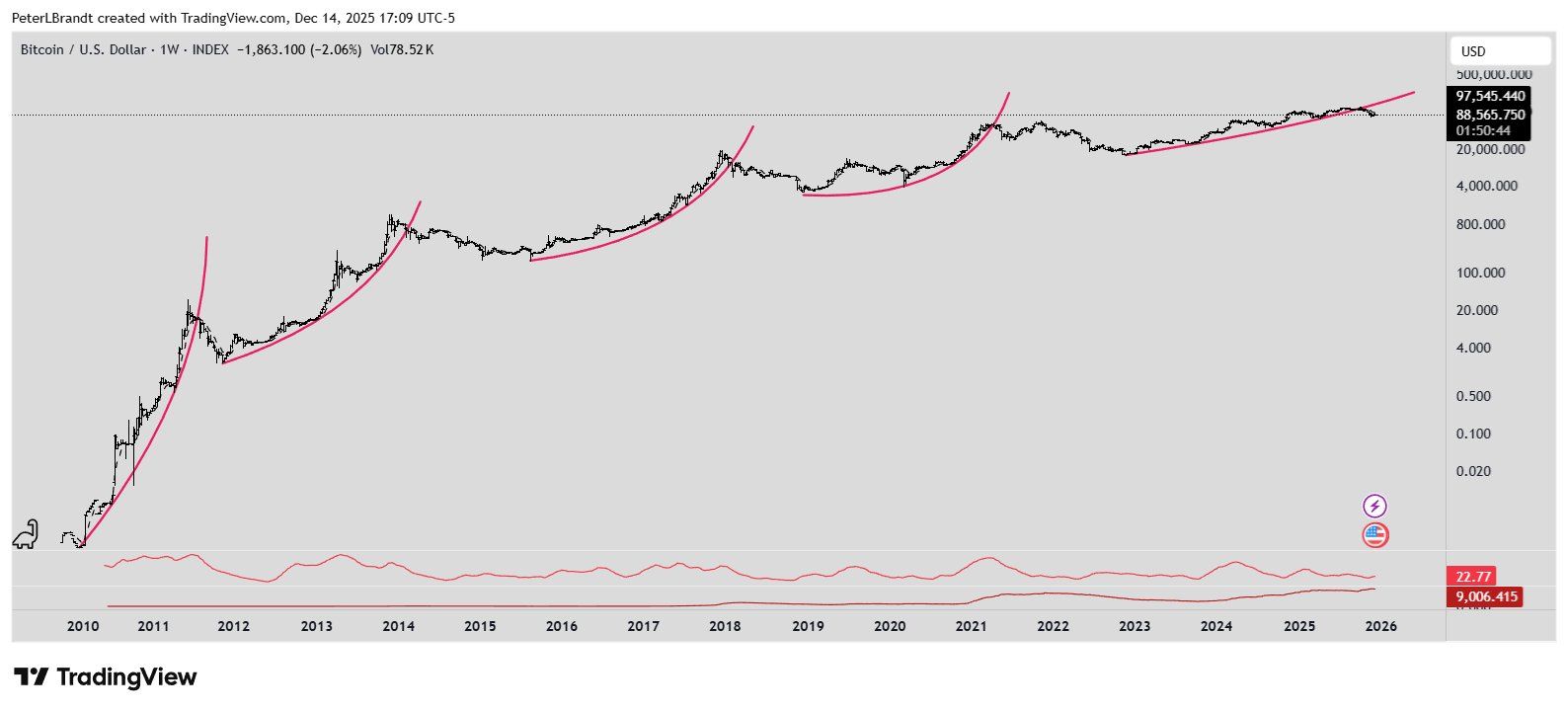
Brandt lays it out on a log-scale chart stretching back to 2010: four steepening pink arcs, each tracing a cycle's manic vertical climb. Parabolas don't bend gently, they accelerate skyward, just like BTC's history of rapid gains.
Meanwhile, crosses below that support line have marked end of bull runs. The slide from October highs has done that, knifing under the fourth arc.
Disclaimer: The content of this article solely reflects the author's opinion and does not represent the platform in any capacity. This article is not intended to serve as a reference for making investment decisions.
You may also like
The Emergence of Clean Energy Derivatives: How CleanTrade is Transforming Institutional Investment in Renewable Resources
- CleanTrade's CFTC-approved SEF designation in 2025 revolutionizes clean energy derivatives by introducing institutional-grade liquidity and standardized trading for VPPAs, PPAs, and RECs. - The platform's $16B notional trading volume within two months demonstrates rapid institutional adoption, with major players like Cargill leveraging its transparent infrastructure to manage energy risks. - Integrated ESG analytics and automated compliance tools enable investors to align portfolios with sustainability g

The Emergence of CFTC-Regulated Clean Energy Platforms and Their Influence on Institutional Investment Approaches
- CFTC-approved CleanTrade, the first SEF for VPPAs/RECs, transforms clean energy markets by addressing liquidity, transparency, and regulatory challenges. - Its $16B trading volume and Cargill-Mercuria's first transaction demonstrate institutional adoption of standardized, verifiable renewable energy assets. - CleanTrade enables ESG alignment through project-specific carbon tracking, reducing emissions by 15% for investors while complying with IRA-driven $2.2T global investments. - By bridging financial a

Clean Energy Market Fluidity and the Rise of CleanTrade: Strategic Considerations for Investors in a Regulatory Environment
- CleanTrade, a CFTC-approved SEF, addresses fragmented pricing and low liquidity in clean energy markets by standardizing VPPA, PPA, and REC trading. - The platform’s $16B in two-month transactions demonstrates institutional demand for transparent, ESG-aligned tools to hedge energy risks and track carbon impact. - By centralizing renewable derivatives and aligning with regulations like SFDR, CleanTrade lowers barriers for investors and developers, accelerating decarbonization while boosting market efficie

The Rise of a Dynamic Clean Energy Marketplace
- Global clean energy investment hit $2.1 trillion in 2024, driven by decarbonization trends and institutional demand. - REsurety's CFTC-approved CleanTrade platform addresses liquidity gaps by standardizing VPPA/REC trading with oil-like transparency. - The platform processed $16 billion in two months, enabling risk mitigation and rapid capital reallocation amid policy shifts. - Advanced analytics and structured workflows transform clean energy assets into tradable instruments, attracting diversified inst

Trending news
MoreCrypto prices
More





