
Zcash's Scheduled Halving in November 2025 and Its Potential Impact on the Market: An Analysis Focused on Supply Constraints
- Zcash’s 2025 halving reduced block rewards by 50%, capping supply at 21M ZEC and aligning with Bitcoin’s deflationary model. - ZIP 1015 lockbox diverted 12% of rewards to a community-controlled wallet, cutting daily liquidity by $337K. - ZEC surged 845% post-halving but later dropped 96%, while Grayscale’s $151.6M trust now holds 5% of supply. - EU’s MiCA framework pressures Zcash to balance privacy with transparency, risking core value proposition. - Upcoming 2028 halving will further cut rewards, reinf
Zcash Halving 2025: Transforming Supply and Privacy
In November 2025, Zcash (ZEC) underwent a significant halving event that reshaped its economic landscape. The reduction of block rewards from 3.125 ZEC to 1.5625 ZEC per block brought Zcash’s issuance model closer to Bitcoin’s, enforcing a maximum supply of 21 million ZEC and lowering annual inflation to just 2%. This adjustment, paired with the ZIP 1015 lockbox—which directs 12% of block rewards into a community-managed multisig wallet—further tightened daily liquidity by $337,000, reinforcing Zcash’s scarcity narrative. For investors, this halving served as both a potential driver for price growth and a test of Zcash’s resilience amid regulatory and market fluctuations.
Shifting Supply and Enhanced Scarcity
The halving fundamentally changed Zcash’s monetary policy. By slashing block rewards, the protocol accelerated its trajectory toward a 2% annual inflation rate by 2032, mirroring Bitcoin’s approach to scarcity. The introduction of the ZIP 1015 lockbox established a two-tier scarcity system: not only are fewer coins released, but a portion is also withheld from immediate circulation and governed by a decentralized, community-controlled wallet. As of November 2025, Zcash’s circulating supply reached about 16.3 million ZEC.

With 70% of transactions now utilizing privacy features, demand for confidential transfers continues to grow, strengthening Zcash’s role as a censorship-resistant store of value.
Market Sentiment and Price Fluctuations
The 2025 halving sparked a dramatic rally, with ZEC surging 845% to reach $650 in the months that followed. However, this rapid ascent was quickly followed by a steep 96% correction within just over two weeks, highlighting the asset’s inherent volatility and the influence of speculative trading. These swings underscore the delicate balance between Zcash’s scarcity-driven fundamentals and its exposure to liquidity shocks. Institutional interest has also intensified, with the $151.6 million Grayscale Zcash Trust now holding 5% of the total supply and new Zcash ETF proposals emerging. While these developments signal growing mainstream acceptance, they also raise concerns about reconciling privacy with regulatory obligations, especially under the EU’s Markets in Crypto-Assets (MiCA) regulations, which demand increased transparency for digital assets.
Regulatory Landscape and Institutional Involvement
Zcash’s hybrid proof-of-stake model and dual transaction types—shielded for privacy and transparent for compliance—enable it to navigate evolving regulatory demands. Shielded transactions protect user anonymity, while transparent transactions allow institutions to meet MiCA’s requirements, providing a compliant entry point for regulated investors. This flexibility has attracted more institutional players, including the Grayscale Trust, which now controls a notable share of Zcash’s circulating supply. Nonetheless, regulatory uncertainty remains a significant challenge. The European Union’s MiCA framework, for example, may require Zcash to adjust its privacy features to comply with transparency standards, potentially impacting its core value proposition.
Speculation Versus Long-Term Investment
For traders, the volatility following the halving has created opportunities for substantial gains, as seen in the 950% price spike in 2025 driven by supply constraints and institutional activity. However, such volatility also brings heightened liquidity risks, as evidenced by the rapid 96% decline. Long-term holders may focus on Zcash’s scarcity mechanisms and the impact of institutional adoption. The ZIP 1015 lockbox, by reducing daily liquidity, supports price discovery, while the upcoming 2028 halving—which will further reduce block rewards to 0.78125 ZEC—reinforces Zcash’s deflationary outlook.
Looking Ahead: Scarcity, Privacy, and Regulation
The November 2025 halving has redefined Zcash’s economic framework, positioning it as a privacy-first asset with scarcity features reminiscent of Bitcoin. While the event has renewed investor enthusiasm and attracted institutional capital, it has also exposed Zcash to regulatory and liquidity challenges. For speculators, Zcash’s price swings offer the potential for significant returns, but long-term investors must weigh these opportunities against the uncertainties posed by MiCA and the broader regulatory environment. As the next halving approaches in 2028, the interplay between scarcity, privacy, and compliance will shape Zcash’s future role in the digital asset landscape.
Disclaimer: The content of this article solely reflects the author's opinion and does not represent the platform in any capacity. This article is not intended to serve as a reference for making investment decisions.
You may also like
Momentum ETF (MMT) and the Intersection of Retail Hype and Institutional Backing in November 2025
- Momentum ETF (MMT) surged 1,330% in Nov 2025 due to retail frenzy and institutional validation. - Binance airdrop and Sui-based perpetual futures DEX boosted retail demand through liquidity and yield incentives. - $10M HashKey funding and $600M TVL validated MMT's institutional credibility under CLARITY Act/MiCA 2.0 frameworks. - ve(3,3) governance model and token buybacks created flywheel effects, aligning retail/institutional incentives. - Q1 2026 Token Generation Lab aims to expand Sui ecosystem proje

Fed Cuts Rates, Announces $40B T-Bill Program, Crypto Dips
U.S. Marine Policy and Blue Economy Prospects: Key Infrastructure and Geostrategic Roles in Oceanic Commerce
- U.S. oceans policy balances geopolitical strategy, deep-sea tech investments, and UNCLOS ratification challenges to secure maritime influence. - Executive actions accelerate seabed mineral extraction while facing environmental criticism and legal risks from bypassing international seabed authority rules. - Offshore energy partnerships with Australia, Japan, and Saudi Arabia aim to diversify supply chains but face geopolitical tensions in chokepoints like the Red Sea. - Maritime security contracts expand

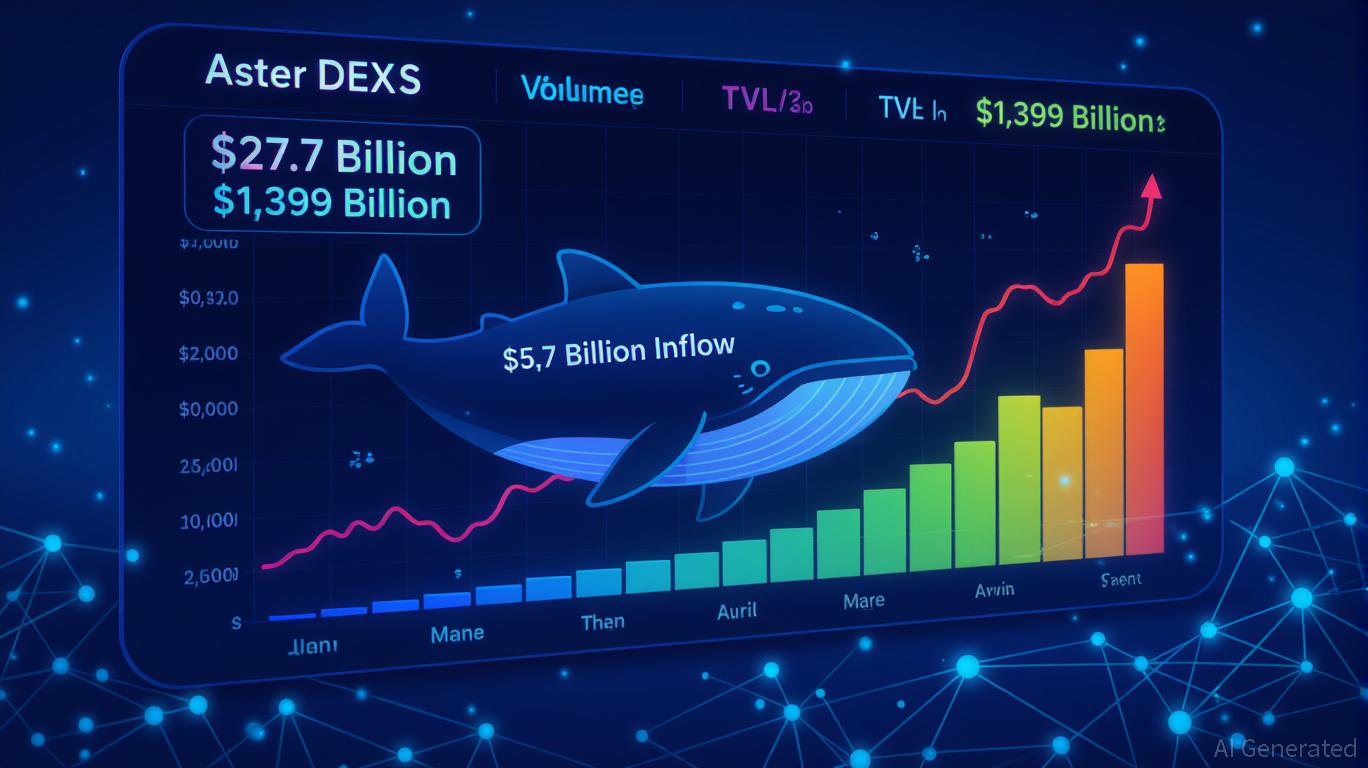
Aster DEX's On-Chain Momentum: Signaling the Future of DeFi
- Aster DEX reported $27.7B daily volume and $1.399B TVL in Q3 2025, outpacing DeFi benchmarks with 2M users. - Institutional whale activity, including CZ's $2M ASTER purchase, drove $5.7B inflows and 800% volume spikes. - Hybrid AMM-CEX model and ZKP privacy tech enabled 40.2% TVL growth, 77% private transactions, and 19.3% perpetual DEX market share. - ASTER's margin trading upgrades and Stage 4 airdrops fueled 30% price surges, while Aster Chain's 2026 launch will integrate privacy-preserving ZKPs. - On
Trending news
MoreCrypto prices
More





