
NFT Market Slumps as Monthly Sales Drop to $320 Million

The NFT market, once thriving, is going through a cold period at the end of 2025. After months of speculation and rampant enthusiasm, the indicators have just turned red. Sales are collapsing, market capitalization is falling, and investors are questioning the future of this emblematic sector of crypto.
In brief
- Monthly NFT sales dropped to $320 million in November 2025, a 50% decrease compared to October.
- Major NFT collections like CryptoPunks, Bored Ape Yacht Club, and Hypurr suffered declines of up to 48%.
- Ethereum may feel the effects of this NFT crisis, although its resilience also relies on other use cases such as DeFi.
NFT: Monthly Sales Reach Their Lowest Level of the Year
The numbers speak for themselves: in November 2025, NFT sales plunged to $320 million, a 50% drop compared to October. This level, the lowest of the year, recalls the volumes of September 2024, when transactions amounted to $312 million. Furthermore, the market’s capitalization has declined by 66% since January, dropping from $9.2 billion to only $3.1 billion.
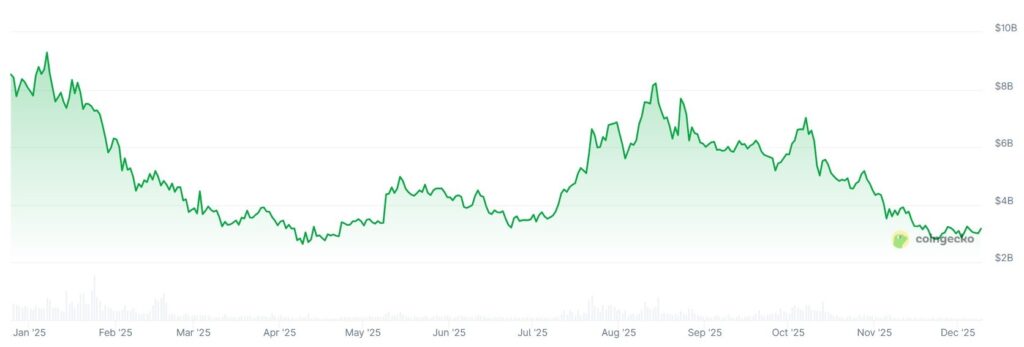 NFT Market Decline.
Leading collections are not spared:
- CryptoPunks, the historical leader, lost 12% of its value in one month;
- Bored Ape Yacht Club and Pudgy Penguins fell by 8.5% and 10.6% respectively;
- The biggest drop goes to Hypurr, with a collapse of 48%;
- Only Infinex Patrons and Autoglyphs resist, showing increases of 14.9% and 20.9%.
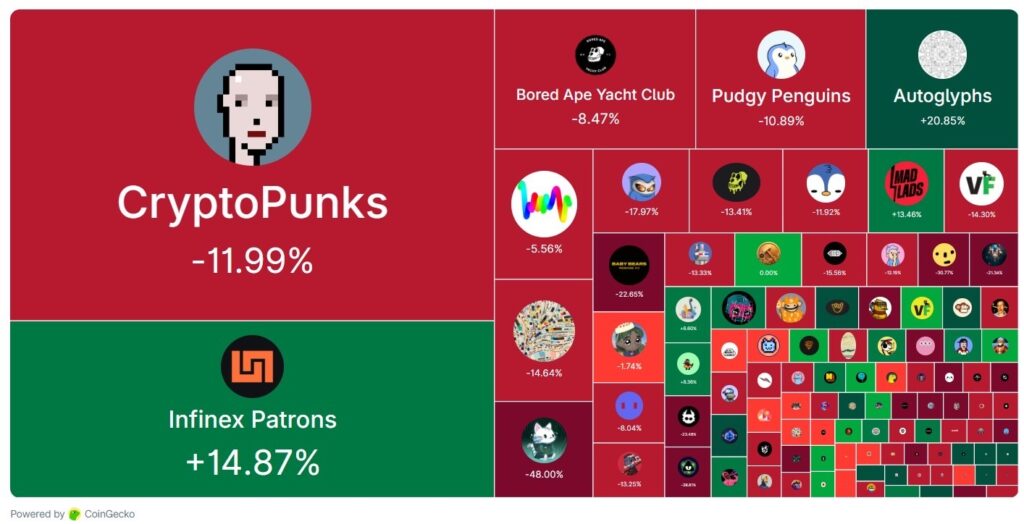 The NFT collections most affected by the crisis.
This downward trend of NFTs continued in early December , with only $62 million in sales recorded in one week, a negative record for 2025.
NFTs Fall: What Risks for the End of 2025?
Several factors explain this sudden cooling of NFTs. First, a natural correction after years of excessive speculation. Indeed, NFTs, often seen as purely speculative assets, are now undergoing a purge, eliminating projects without real utility. Next, the macroeconomic context plays a key role: restrictive monetary policies and geopolitical uncertainties weigh on all markets, including crypto.
The consequences are already visible. Liquidity is drying up, investors are withdrawing, and many projects are closing doors. Market players, platforms and creators, might face restructuring or layoffs by the end of the year. The risks for the coming months are real. If the trend does not reverse, investor confidence could erode further, extending this NFT winter well beyond 2025.
Ethereum on the Brink of Crisis Due to NFTs?
Ethereum still dominates the NFT market, holding a majority share of collections issued on its blockchain. Such dependence exposes ETH to sector shocks. Historically, NFT sales declines have often coincided with ETH price corrections. In 2021 and 2022, for example, drops in NFT volumes preceded significant ETH recessions.
However, Ethereum is not limited to this use case alone. The blockchain remains a pillar of decentralized finance (DeFi) and smart contracts, giving it some resilience. Developers and investors might turn to other applications, reducing the impact of the NFT crisis. Nevertheless, if NFT declines persist, it could weigh on ETH demand, affecting its price in the short to medium term.
The NFT winter is settling in for the long term, with sluggish sales and plummeting capitalization. This decline, although brutal, could mark the end of a speculative era and the beginning of a more mature phase, focused on the real utility of digital assets . In your opinion, is this crisis just a correction or a sign of a deeper decline in the NFT market?
Disclaimer: The content of this article solely reflects the author's opinion and does not represent the platform in any capacity. This article is not intended to serve as a reference for making investment decisions.
You may also like
B Capital co-founder Kabir Narang departs to establish a new investment venture
Why the CEO of Cursor is confident that competition from OpenAI and Anthropic won’t overwhelm his startup
SpaceX is said to be aiming for an IPO in 2026, targeting a valuation of $1.5 trillion
Cashew Research is targeting the $90B market research sector by leveraging AI technology
Trending news
MoreCrypto prices
More





