
JPMorgan Denies Political Motive Behind Crypto Account Closure Tied to Trump

Crypto account closures reignite controversy between financial institutions and conservative figures. JPMorgan is indeed accused of targeting pro-Trump users. Its CEO, Jamie Dimon, firmly rejects this version.
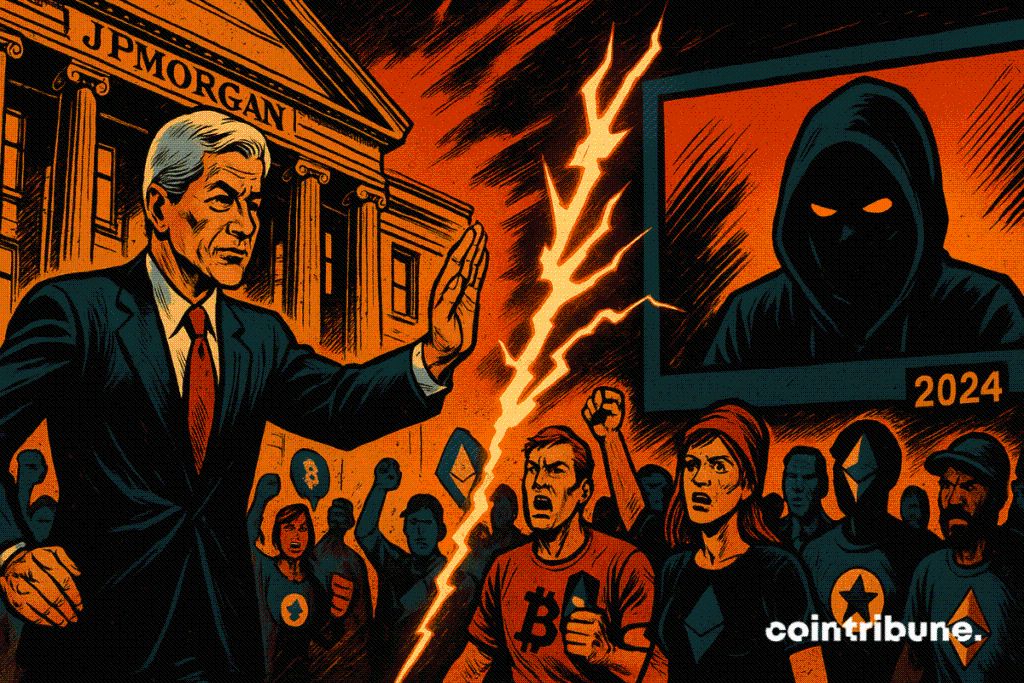
In brief
- JPMorgan denies targeting crypto actors for political or ideological reasons.
- Jamie Dimon calls for reform of debanking rules deemed unclear and unfair.
Crypto and account closure: accusations rain down on JPMorgan
Several personalities in the crypto sector denounce the closure of their bank accounts by JPMorgan, without clear justification.
- The CEO of Strike Jack Mallers claims, for example, to have lost access to his personal funds.
- Trump Media, headed by Devin Nunes, mentions a similar blockage.
- The same scenario on the crypto platform ShapeShift.
These incidents revive fears of a new “Operation Chokepoint”. Some administrations use this controversial method to restrict access to crypto banking services.
Jamie Dimon, JPMorgan CEO, categorically rejects these allegations during an interview with Fox News.
The debate actually touches a sensitive point: the neutrality of banks in the face of the rise of digital assets. More precisely referring to the massive debanking that raises the question of possible financial censorship hidden behind vague compliance rules.
Crypto, Trump and regulation: Jamie Dimon’s strong defense
Jamie Dimon affirms he has been advocating for 15 years to reform the rules that push banks to close accounts on mere suspicion or media reporting. He thus calls for a clarification of the financial regulation standards imposed on banks.
Dimon reminds that JPMorgan never delivers information to authorities without a subpoena. However, he accuses the political climate of turning banks into easy targets. For him, the problem comes from the law (and not the intentions of the institution).
The crypto community therefore fears an abusive use of these procedures, seen as a barrier to decentralized finance. In a context where digital wallets are gaining popularity, each incident fuels distrust toward traditional actors.
In any case, the war between crypto supporters and traditional banks seems far from settled. Regulation will have to decide between control and innovation, before a real gap grows between two visions of finance.
Disclaimer: The content of this article solely reflects the author's opinion and does not represent the platform in any capacity. This article is not intended to serve as a reference for making investment decisions.
You may also like
The Financial Wellness Factor: An Overlooked Driver of Sustainable Wealth Building
- Financial wellness combines objective financial health and subjective well-being to drive long-term wealth creation, beyond mere asset accumulation. - Behavioral traits like conscientiousness correlate with disciplined investing habits, while neuroticism increases impulsive decisions during market volatility. - Studies show financially literate investors maintain portfolios during downturns, with 38% of "content" quadrant participants achieving superior risk-adjusted returns. - Debt management and saving

Aster DEX’s Latest Protocol Update and What It Means for DeFi Liquidity Providers
- Aster DEX's v2 upgrade enhances capital efficiency and privacy for liquidity providers (LPs) through ASTER token collateral and leveraged trading features. - The "Trade & Earn" functionality boosted TVL to $2.18B by November 2025, leveraging yield-bearing assets as trading margin. - However, 300x leverage and reduced tick sizes increase liquidation risks during volatility, while fee stagnation below $20M contrasts with $2B daily trading volumes. - Upcoming Aster Chain's privacy tools aim to attract insti

PEPE Steadies at $0.054711 With Narrow Range Shaping Short-Term Outlook

PEPE Maintains Structured Movement After 2.8% Gain as Analysts Watch Narrow Range

Trending news
MoreCrypto prices
More





