
What Happens to Tether if Japan Dumps US Treasuries? Depeg Risks Explained

Japan, the world’s largest foreign holder of US government debt, is stoking market anxiety as analysts warn that a potential large-scale bond sell-off could be approaching. The concern is rippling into the crypto sector, where Tether, issuer of the USDT stablecoin backed primarily by over $113 billion in US Treasuries, faces renewed scrutiny over possible
Japan, the world’s largest foreign holder of US government debt, is stoking market anxiety as analysts warn that a potential large-scale bond sell-off could be approaching.
The concern is rippling into the crypto sector, where Tether, issuer of the USDT stablecoin backed primarily by over $113 billion in US Treasuries, faces renewed scrutiny over possible depeg risks.
Analysts Warn Japan Could Dump US Treasuries as Domestic Yields Surge
According to the latest data from the US Department of the Treasury, foreign appetite for US Treasuries weakened in September. Total overseas holdings edged down to $9.249 trillion, a slight dip from August.
Nonetheless, Japan was the exception to this slowdown. The country extended its nine-month buying streak, increasing its holdings to $1.189 trillion, the highest amount it has held since August 2022. This reinforces Japan’s long-standing position as the largest foreign owner of US Treasuries.
“They bought foreign debt because Japanese bonds yielded almost nothing,” an analyst stated.
That spread made US debt an attractive, low-risk yield alternative. But the macro backdrop is shifting. As BeInCrypto previously highlighted, yields on Japanese government bonds have climbed to their highest levels in years.
With domestic yields improving, the incentive to continue accumulating US Treasuries weakens. It also raises the possibility that Japan may reduce its exposure if market conditions or policy priorities shift further.
“Japan’s long-ignored debt crisis is surfacing, as its 230% debt-to-GDP burden collides with a massive new fiscal expansion under PM Sanae Takaichi, triggering a sharp spike in bond yields and investor alarm. A shock in Japan could reverberate worldwide, especially given Tokyo’s role as the largest buyer of U.S. Treasuries, raising the stakes for global markets already strained by rising borrowing costs and shrinking fiscal room,” Lena Petrova stated.
This could also hurt the US if Japan has to sell hundreds of billions of Dollars worth of US Treasuries for cash to defend their currency exchange rate or to use for domestic bailouts or other expenditures
— Jason Burack (@JasonEBurack) November 24, 2025
An analyst further highlighted that the yield spread between US and Japanese bonds has narrowed from 3.5% to 2.4% in six months. The hedged return on Treasuries has turned increasingly unattractive. The post warned that if the spread approaches 2%, repatriation becomes economically compelling.
That could prompt Japanese institutions to sell US government bonds and reallocate capital domestically. Some models suggest as much as $500 billion may exit global markets in 18 months.
“Then there’s the yen carry trade, roughly $1.2 trillion borrowed cheaply in yen and deployed around the world into stocks, crypto, EM, anything with yield. As Japanese rates rise and the yen strengthens, those trades turn toxic. Positions unwind. Forced selling accelerates….For 30 years, Japanese yields acted as the anchor keeping global rates artificially low. Every portfolio built since the mid-90s has quietly relied on that anchor. Today, it snapped,” the analyst added.
Tether’s US Treasury Exposure Draws Focus
The question many analysts are now asking is straightforward: If Japan begins reducing its Treasury holdings, what does that mean for USDT? The concern arises because Tether’s reserve structure is heavily concentrated in the same asset class that could come under pressure.
According to Tether’s transparency report, more than 80% of its reserves are in US Treasuries. This makes it a major participant in the global Treasury ecosystem, and remarkably, the 17th largest holder of US government debt worldwide, surpassing many sovereign entities.
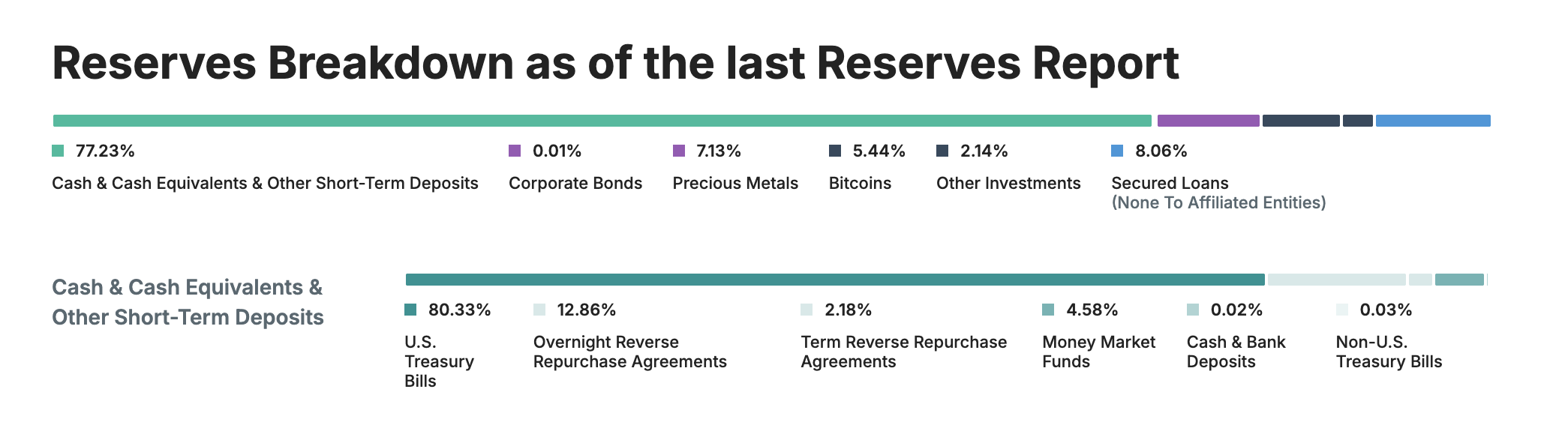 Tether Reserves Composition. Source:
Such concentration has advantages and vulnerabilities. Treasuries offer high liquidity and historically strong price stability. However, if a major foreign creditor like Japan begins to unwind its holdings, the resulting volatility in bond prices or yields could tighten liquidity conditions, indirectly pressuring large holders like Tether.
“Japan will be forced to sell US bonds, the rest of the world will follow. Tether will suffer a sharp depeg and Bitcoin will sink as a result. MicroStrategy will be forced to sell and this will further depress the Bitcoin price. Japan ➡️Tether➡️Bitcoin In this order,” a market watcher wrote.
Adding to these concerns, S&P Global Ratings downgraded its assessment of Tether’s ability to maintain its peg, moving USDT from a score of 4 (constrained) to 5 (weak). According to the evaluation,
“5 (weak) reflects the rise in exposure to high-risk assets in USDT’s reserves over the past year and persistent gaps in disclosure. These assets include bitcoin, gold, secured loans, corporate bonds, and other investments, all with limited disclosures and subject to credit, market, interest-rate, and foreign-exchange risks.”
Despite these macro-driven concerns, most market participants see little chance of a forced Tether depeg. Traders on the Opinion prediction market assign a 0.5% probability to the scenario, showing high investor skepticism.
 Odds of USDT Depegging. Source:
Several factors explain this skepticism. Tether has maintained its peg during previous market crises. The firm generated $10 billion in profit through Q3 2025, offering a substantial buffer against reserve swings.
Although Japan’s Treasury exit could be significant, it will likely unfold gradually. US Treasury markets remain vast and can absorb pressure from selling without huge disruptions. Even so, the combination of Japan’s yield rise, S&P’s downgrade, and Tether’s reserve mix requires close monitoring.
Disclaimer: The content of this article solely reflects the author's opinion and does not represent the platform in any capacity. This article is not intended to serve as a reference for making investment decisions.
You may also like
The ZK Atlas Upgrade: Revolutionizing the Infrastructure of Decentralized Finance
- ZKsync's 2025 Atlas Upgrade achieves 43,000 TPS with $0.0001 fees, outperforming Ethereum and most Layer-2 solutions. - Deutsche Bank , Sony , and Citi adopt ZKsync for cross-chain settlements and tokenized assets, boosting TVL to $3.5B by 2025. - ZK token surged 150% post-upgrade, with analysts projecting 60.7% CAGR growth to $90B by 2031 for ZK-based solutions. - Upcoming Fusaka upgrade aims to double throughput, but faces regulatory risks and competition from StarkNet and Scroll.

Financial Wellness Emerging as a Key Trend for Consumers and Investors: How Financial Knowledge and Learning Drive Change
- The financial wellness industry is transforming through tech innovation, shifting consumer priorities, and rising demand for financial literacy education. - Market research projects the global financial literacy sector will surpass $8.6B by 2033, driven by Gen Z/Millennial demand for gamified/digital-native learning tools. - Investment opportunities span edtech platforms, micro-investing apps, and corporate partnerships integrating financial education into mainstream services. - Challenges include regula

Pudgy Penguins (PENGU) To Rise Further? This Potential Bullish Pattern Formation Suggests So!

Is Sei (SEI) Poised For a Breakout? This Key Bullish Pattern Suggests So!

Trending news
MoreCrypto prices
More





