
Grasping the Factors Leading to Solana's Recent 50% Decline in Value
- Solana's 50% price drop in early 2025 stemmed from token unlocks, declining network activity, and the Libra meme token collapse. - Network metrics like active addresses (-40%) and TVL ($2.87B loss) revealed weakening ecosystem trust and liquidity. - Broader crypto market declines (Bitcoin to $86K) and macroeconomic risks accelerated Solana's sell-off amid rising trade war fears. - $500M liquidity migration to Ethereum and institutional ETF launches signaled cautious optimism despite ongoing volatility. -
Solana’s Dramatic Price Plunge: An In-Depth Analysis
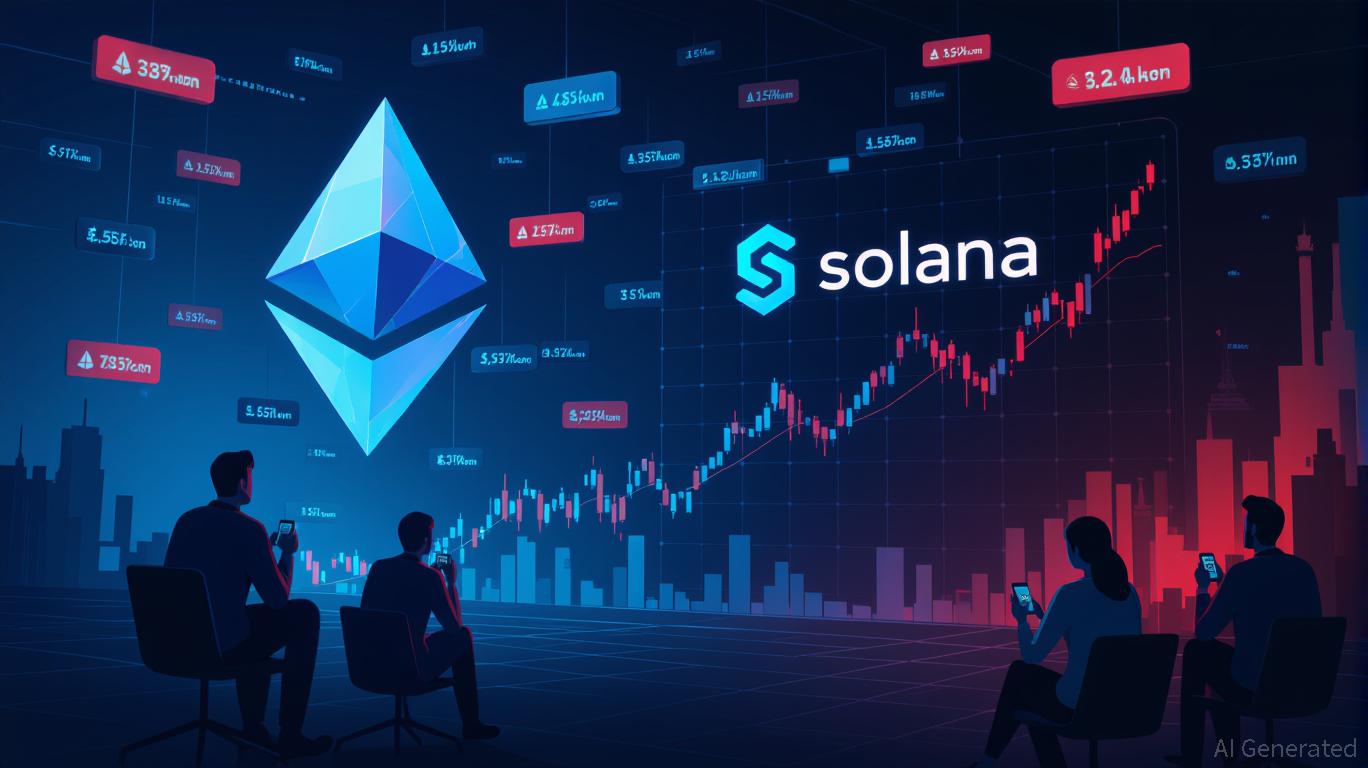
The cryptocurrency sector is no stranger to wild price swings, but Solana’s (SOL) sharp 50% decline—from its peak of $295 in January 2025 to just $132 by late February—stands out as a vivid example of how technical, market, and global economic factors can collide. While the drop was unsettling, it also sheds light on crucial risk management lessons and exposes the vulnerabilities of rapidly expanding blockchain networks.
Token Unlocks and Supply Pressures: The Catalyst
Solana’s rapid descent was triggered by a scheduled release of 11.2 million SOL tokens on March 1, 2025. This unlock, which distributed tokens to early backers and developers, led to a surge in selling as traders braced for increased supply and potential value dilution. Additional, smaller unlocks in the following months only deepened negative sentiment, shaking confidence in SOL’s price stability. These events underscore the risks inherent in tokenomics that depend on staggered vesting, especially in markets where liquidity can vanish quickly during downturns.
Declining Network Activity and Ecosystem Weakness
The price drop was accompanied by a significant reduction in network engagement. Active wallet addresses plummeted from 5.7 million to 3.5 million in just a month, while decentralized exchange (DEX) trading volumes and network fees also saw steep declines. This pointed to fading user participation and eroding trust in the platform. The Total Value Locked (TVL) in Solana’s DeFi protocols fell from $10 billion to $7.13 billion, highlighting how fragile decentralized finance can be during uncertain times. For investors, these metrics serve as early warnings—price movements often lag behind deeper ecosystem issues.
The Libra Meme Token Crash: Ripple Effects
Solana’s troubles were compounded by the spectacular collapse of the Libra meme token, which soared to a $4.6 billion valuation before crashing below $100 million. As a major hub for memecoin activity, Solana’s liquidity was severely impacted, revealing the dangers of heavy reliance on speculative tokens. This episode illustrates how the downfall of a single project can send shockwaves through an entire blockchain ecosystem.
Wider Market and Economic Headwinds
Solana’s struggles mirrored a broader slump in the crypto market, with Bitcoin itself dropping to nearly $86,000. Global economic anxieties, including fears of trade disputes and rising inflation, drove investors toward safer assets, intensifying the sell-off. These trends highlight the growing importance of understanding macroeconomic forces in crypto investing, as digital assets become increasingly sensitive to global financial shifts.
Liquidity Exodus and Rising Competition
More than $500 million in liquidity exited Solana for rival platforms like Ethereum and Arbitrum during February 2025 alone. This migration reflects the fiercely competitive nature of blockchain technology, where user preferences and innovation can quickly redirect capital. Solana now faces the challenge of maintaining its status as a leading Layer-1 blockchain while addressing the liquidity issues that have prompted users to seek alternatives.
Adapting Risk Management: Community Responses
To counteract the volatility, organizations within the Solana ecosystem have implemented new risk management strategies. SOL Strategies Inc. expanded its influence by acquiring Laine’s validator network and Stakewiz.com, boosting their staked SOL holdings to 3,391,092 tokens. Despite impressive validator performance—99.955% uptime and a 7.41% average APY—the broader market’s 12.5% decline in March 2025 revealed the limits of technical robustness when faced with systemic risks.
Diversification has become a key takeaway for investors. Experts recommend balancing exposure to riskier altcoins with stablecoins and Bitcoin to cushion against individual asset failures. Meanwhile, Solana Co reported a net loss of $352.8 million in Q3 2025, reflecting the financial strain on firms deeply tied to the Solana ecosystem. Nevertheless, the company’s focus on accumulating Solana shares and attracting institutional investors signals a commitment to long-term growth.
Signs of Recovery: Institutional Interest Returns
By October and November 2025, institutional investors began returning to Solana, with inflows exceeding $381 million—outpacing those of other altcoins. The introduction of the Bitwise Solana ETF (BSOL) and the REX-Osprey Solana + Staking ETF, which raised $417 million and $421 million respectively, further demonstrated renewed confidence. Technological advancements, such as the Firedancer validator client and the Alpenglow consensus protocol, slashed validator costs by 80% and improved block finality to just 100–150 milliseconds. These upgrades have positioned Solana as a strong contender for real-time financial applications, even as price volatility persists.
Looking Ahead: Lessons and Opportunities
Solana’s dramatic price correction serves as a stark reminder of the risks inherent in the crypto market. While token unlocks, declining network activity, and isolated shocks played significant roles, broader economic trends and competitive pressures were also at play. For investors, strategies such as diversification, institutional-grade staking, and a focus on long-term technological innovation remain essential. As Solana continues to evolve—with growing institutional support and ongoing technical improvements—its recovery will depend on restoring trust and proving its lasting value in an ever-changing landscape.
Disclaimer: The content of this article solely reflects the author's opinion and does not represent the platform in any capacity. This article is not intended to serve as a reference for making investment decisions.
You may also like
HYPE Token Experiences Rapid Growth: Temporary Craze or the Beginning of a Fresh Cryptocurrency Movement?
- Hyperliquid's HYPE token surged 15.50% in 7 days, capturing 72.7% of top DEX perpetual trading volume in 2025. - The HIP-3 upgrade enabled permissionless futures markets via HYPE staking, boosting platform utility and liquidity. - Social media-driven speculation and technical indicators fueled volatility, with price swings between $32.40 and $38.50. - Critics highlight risks of sentiment-driven demand, noting HYPE's FDV of BTC469M relies on sustained DeFi growth and innovation. - Investors face a high-ri
White House economic advisor Hassett: Interest rates should continue to be lowered.
Trump: A single rule executive order on artificial intelligence will be issued this week.
Hassett: Trump will release a lot of positive economic news.
Trending news
MoreCrypto prices
More





