
Powell Avoids Policy Talk, But Inflation Remarks Draw Interest

US Federal Reserve Chair Jerome Powell delivered remarks at the George P. Shultz Memorial Lecture at Stanford’s Hoover Institution on December 1st. He deliberately avoided discussing current economic conditions or monetary policy, although his historical remarks carried implicit significance for current debates. Timing Raised Questions The timing of Powell’s appearance sparked considerable interest among market
US Federal Reserve Chair Jerome Powell delivered remarks at the George P. Shultz Memorial Lecture at Stanford’s Hoover Institution on December 1st.
He deliberately avoided discussing current economic conditions or monetary policy, although his historical remarks carried implicit significance for current debates.
Timing Raised Questions
The timing of Powell’s appearance sparked considerable interest among market watchers. With the next FOMC meeting just nine days away and market expectations for rate cuts rising, many had hoped for signals about the Fed’s policy direction.
Additionally, speculation has intensified that President-elect Trump may announce his Fed chair pick within the month, with Kevin Hassett among the likely candidates. Powell’s term expires in May 2026.
However, Powell declared at the outset, “I will not address current economic conditions or monetary policy,” and focused on celebrating the legacy of the late George Shultz.
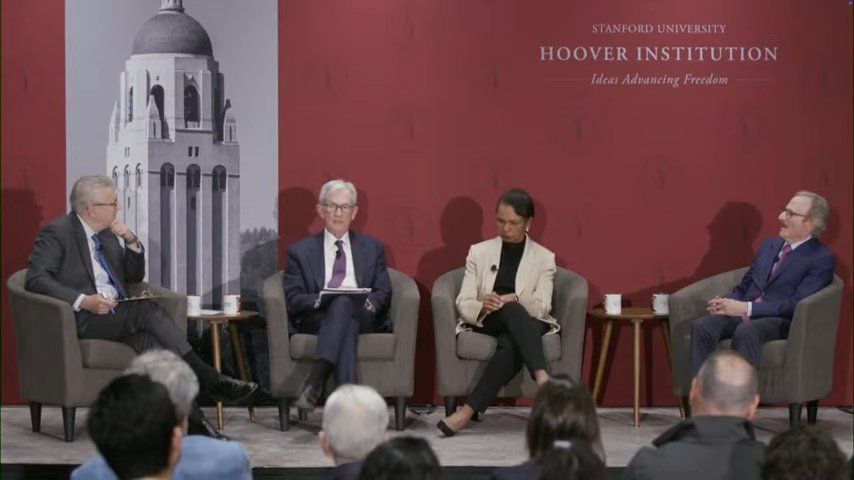 US Fed Chair Jerome Powell participated in George P. Shultz Memorial Lecture Series: Shultz And Economic Policy. Captured from YouTube.
While Powell avoided current policy discussions, his historical commentary on inflation carried implicit significance. Reflecting on the wage and price controls of the Nixon era, Powell emphasized the evolution of economic understanding:
“Our understanding of the economy is ever evolving… certain things that are sometimes accepted as conventional wisdom, people will look back in 50 years and think, what were they thinking?”
Powell’s remarks carried dual meaning. It was both humility—even the Fed can be wrong—and defense: today’s criticism may look different with hindsight.
Many analysts noted connections between his historical references and current monetary conditions. As the Fed concluded the period of quantitative tightening, it halts the Fed’s reduction of liquidity, potentially stabilizing conditions for banks, investment funds, and entities exposed to risk assets.
Price Stability Is “Settled”
Most notably, Powell affirmed the Fed’s mandate on price stability. “We understand now that the central bank is responsible for price stability,” he stated. “That issue is settled. It doesn’t mean it’s easy to do, but the issue is settled.”
This assertion of the Fed’s mandate comes at a particularly charged moment. The Trump administration has signaled interest in reshaping Fed leadership, as National Economic Council Director Kevin Hassett said, “Monetary policy has gotten very complicated… I think we’ve got to simplify things.”
Powell’s emphasis on central bank responsibility may carry a subtle message. The Fed’s independence remains a sensitive topic in Washington. Powell reinforced the Fed’s long-standing commitment to independence and data-driven decisions. These points suggest a desire for continuity, even amid political pressure.
Powell praised Shultz’s approach to policymaking, combining “strong principles and unshakable integrity with practical problem solving.” Powell also highlighted Shultz’s belief in market wisdom, noting, “He had a deep belief in the wisdom of markets.” Observers suggested this could reflect Powell’s own professional credos as he navigates his final months as Fed chair.
The Hoover Institution at Stanford-hosted event, moderated by Peter Robinson and featuring former Secretary of State Condoleezza Rice and economist Michael Boskin, honored Shultz’s contributions to economic policy spanning five decades.
Disclaimer: The content of this article solely reflects the author's opinion and does not represent the platform in any capacity. This article is not intended to serve as a reference for making investment decisions.
You may also like
Evaluating the Influence of MMT on Market Fluctuations in 2025
- Modern Monetary Theory (MMT) drives 2025 fiscal expansion, reshaping global markets through deficit-financed AI and infrastructure investments. - U.S. equity markets benefit from MMT-aligned stimulus, while emerging markets show resilience via fiscal reforms and commodity-linked growth. - Commodity volatility rises as MMT-fueled demand clashes with supply constraints, amplified by dollar strength and climate disruptions. - IMF advocates "credible frameworks" to balance MMT's growth potential with inflati
COAI Experiences Sharp Decline in Share Value: Regulatory Oversight and Changing Investor Attitudes Impact India's Cryptocurrency Industry
- India's 2025 crypto crackdown triggered COAI's sharp share price drop as FIU-IND targeted 25 offshore exchanges for AML violations. - SEBI banned finfluencer Avadhut Sathe for ₹601 crore in unregistered investment advice, exposing systemic risks in influencer-driven trading. - Regulatory uncertainty and 30% crypto tax dampened investor confidence, with COAI's decline linked to both enforcement actions and $5.6B forex reserve losses. - Experts warn India's punitive approach risks stifling innovation despi

The Impact of New Technologies on Improving Educational Programs and Boosting Institutional Effectiveness
- Global EdTech and STEM markets are transforming via AI, cybersecurity, and VR/AR integration, driving curricular innovation and institutional scalability. - Farmingdale State College exemplifies this shift, boosting enrollment 40% through AI/cybersecurity programs and securing $75M for a new tech-focused campus center. - AI-in-education market alone is projected to grow from $5.88B in 2024 to $32.27B by 2030, with EdTech overall expected to reach $738.6B by 2029 at 14.13% CAGR. - Government funding and i

Navigating the Fluctuations of the Cryptocurrency Market: Smart Entry Strategies for Individual Investors
- KITE token's 2025 price surge highlights retail-driven volatility, with 72% trading volume from individual investors. - FDV ($929M) far exceeding initial market cap ($167M) fueled FOMO and panic selling amid rapid 38.75% gains followed by 16% corrections. - Strategic approaches like DCA and stop-loss orders are critical for managing risks in speculative crypto markets dominated by emotional trading behavior.

Trending news
MoreCrypto prices
More





