
Could Tokenized Gold Become the Next Standard in Stablecoins?

Tokenized gold is gaining momentum as geopolitical uncertainty and rising gold prices weaken trust in fiat-backed assets. Major institutions and sovereign actors are launching or expanding gold-backed tokens. This shift suggests tokenized gold may soon move beyond its niche role amd become a credible next-generation, stable, and globally usable digital value. A Five-Year Flight to
Tokenized gold is gaining momentum as geopolitical uncertainty and rising gold prices weaken trust in fiat-backed assets. Major institutions and sovereign actors are launching or expanding gold-backed tokens.
This shift suggests tokenized gold may soon move beyond its niche role amd become a credible next-generation, stable, and globally usable digital value.
A Five-Year Flight to Safety
The turbulence of the past few months has reinforced the role of gold as a safe-haven asset. It was only two months ago that the metal’s price hit a record, surpassing $4,000 per ounce.
This isn’t only a recent phenomenon. Between 2020 and 2025, the price of gold more than doubled, reflecting a wider flight to safety as global markets confronted a pandemic, inflation, wars, sanctions, and persistent geopolitical tensions.
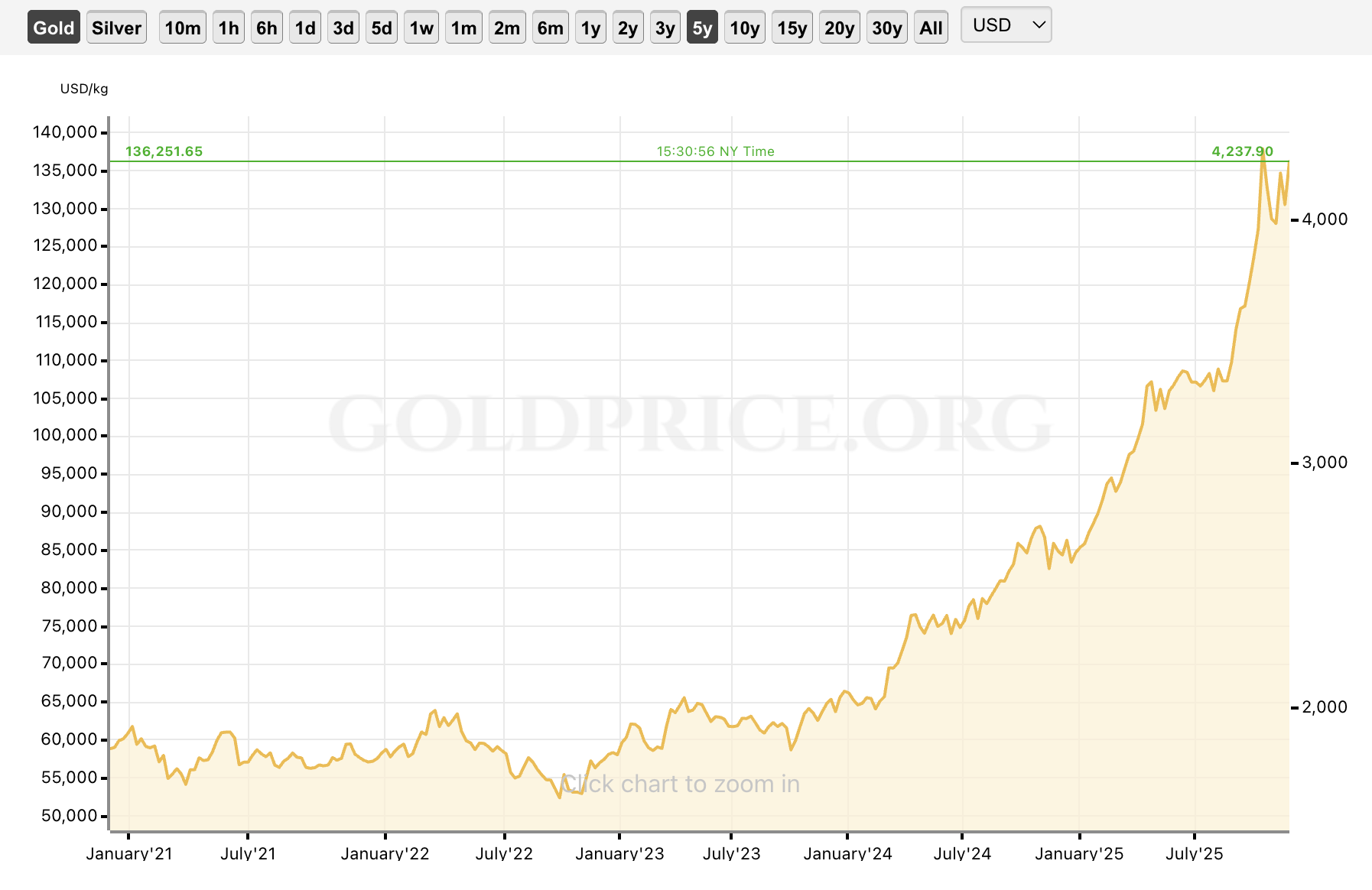 The price of gold over the past five years. Source:
Gold Price.
The price of gold over the past five years. Source:
Gold Price.
At the same time, advances in blockchain technology have transformed the use of gold. Tokenization, instant settlement, and 24/7 global liquidity now make a traditionally static asset far more flexible in digital form.
Several developments show how quickly the trend is gaining traction across both crypto and traditional finance.
Institutional Gold Tokens on the Rise
Last month, Swiss metals giant MKS PAMP, one of the world’s largest gold refiners and a major supplier of precious metals to global markets, relaunched DGLD, a gold-backed token designed for institutional investors.
In the crypto space, Tether Gold (XAUt) continues to see steady growth. Pax Gold (PAXG), launched by New York–regulated blockchain firm Paxos, is also expanding. Together, their market caps now exceed $3 billion, making them the most widely used gold-backed digital assets available to the public.
What if "Digital Gold" is really tokenized gold?$1b to $3b YTD with trillions to go.
— Emperor Osmo 🐂 🎯 (@Flowslikeosmo) November 28, 2025
Traditional banking players are also testing the waters. HSBC, one of the largest multinational banks and a major custodian of physical gold through its London vaults, is experimenting with its own gold token for clients.
While these digital gold products are still relatively small compared to the market value of gold exchange-traded funds (ETFs), their expansion signals a growing confidence that blockchain-based gold is becoming a credible financial instrument.
In fact, the movement is not even limited to the private sector.
In November, Kyrgyzstan launched USDKG, the first gold-backed stablecoin pegged to the US dollar. Backed by the country’s national gold reserves, it offers a sanction-resistant tool for cross-border payments and trade. Kyrgyzstan’s approach could also encourage other, larger nations to follow suit.
Still, some challenges remain.
Regulators Stay Wary
Gold-backed tokens still have no clear industry standard, which makes it harder for users to compare their reliability.
Transparency also varies. Some issuers publish regular third-party audits, while others offer limited details about their vaults or redemption processes. Regulations differ widely across countries, adding another layer of uncertainty for consumers and businesses.
These gaps explain why many governments remain cautious.
Officials worry that freely circulating gold-backed assets could weaken confidence in national currencies and complicate monetary policy. They also fear that digital gold could facilitate the movement of money outside traditional banking controls.
Even so, momentum is unmistakable.
If clearer rules and rising geopolitical pressures push the industry forward, tokenized gold could move from the margins to become a core pillar of stable, globally usable digital money.
Disclaimer: The content of this article solely reflects the author's opinion and does not represent the platform in any capacity. This article is not intended to serve as a reference for making investment decisions.
You may also like
Zcash Halving: What It Means for Cryptocurrency Investors in 2025
- Zcash's 2028 halving will reduce annual inflation to 1%, reinforcing its deflationary model after prior 50% block reward cuts in 2020 and 2024. - The 2024 halving triggered 1,172% price surge followed by 96% drop, highlighting volatility risks despite growing institutional investments like Grayscale's $137M Zcash Trust. - Privacy-focused hybrid model (shielded/transparent transactions) attracts institutional interest but faces EU MiCA regulatory scrutiny, requiring selective compliance strategies. - Inve
CleanTrade and the Evolution of Clean Energy Markets: Market Fluidity, Openness, and the Role of the CFTC
- CleanTrade, a CFTC-approved SEF, transforms clean energy markets by integrating VPPAs, PPAs, and RECs under institutional-grade transparency. - The platform unlocks liquidity through real-time pricing and centralized trading, accelerating net-zero transitions for corporations and utilities . - Enhanced transparency via project-specific REC data combats greenwashing, while regulatory alignment boosts investor confidence and market legitimacy. - By bridging traditional and renewable energy markets, CleanTr

The CFTC-Authorized Clean Energy Marketplace: An Innovative Gateway for Institutional Investors
- REsurety’s CleanTrade platform, CFTC-approved as a SEF, addresses clean energy market illiquidity and opacity by centralizing VPPAs, PPAs, and RECs. - Within two months of its 2025 launch, it attracted $16B in notional value, enabling institutional investors to streamline transactions and reduce counterparty risk. - By aggregating market data and automating compliance, CleanTrade enhances transparency, aligning with ESG priorities and regulatory certainty for institutional portfolios. - It democratizes a

SOL Drops 50%: Is This a Healthy Market Adjustment or the Onset of a Major Sell-Off?
- Solana's 50% price drop sparks debate over whether it signals a bear market correction or deeper structural selloff. - On-chain metrics show liquidity contraction and reduced exchange supply, but ETF inflows and validator activity suggest structural resilience. - Corporate transfers and the Upbit hack highlight volatility risks, while Solana's alignment with Bitcoin's trend underscores macroeconomic influence. - Key watchpoints include liquidity recovery timelines, ETF inflow sustainability, and potentia
Trending news
MoreCrypto prices
More





