
Goodbye or "Goodbye"? The Golden Age of Value Investing

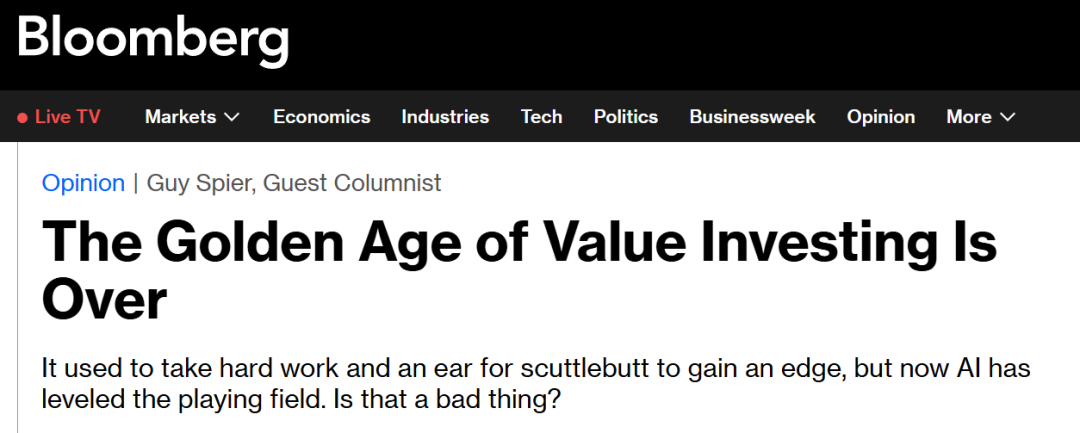
Spier founded Aquamarine Fund in1997, managing about$500 million in assets. He calls himself a "devoted disciple" of Warren Buffett.In 2007, he and investment masterMohnish Pabraijointly bid$650,000 to win a charity lunch with Buffett.
Since the fund's inception inSeptember 1997, Aquamarine Fund's annualized compound return has exceeded9%, slightly higher than the S&P500's annualized return. He has also become one of the few fund managers who can consistently deliver slightly higher returns than the S&P500 index for investors, while significantly reducing the risk of long-term losses.

Why did value investor Spier publish this seemingly clickbait article? Mainly because of the impact of the rapid development of artificial intelligence.
At that time, Spier often faced a question that every fund manager encounters:
Perhaps their subtext is, do you have inside information? Or, do you have unique insights?
No matter the method, Spier believes, everything an investor does is to
Spier reflected on his 30 years of value investing experience, saying: if I truly have an edge, it comes from 'putting my head down and researching.'
Once upon a time, everything was slow. Obtaining knowledge was difficult. In the past, investors could only get information through heavy research, phone calls, and mailing annual reports. This"hard acquisition ability" helped him build his edge. Moreover, various pieces of information had to be carefully pieced together and painstakingly collected. The accumulation of investment knowledge was measured in 'days' or even 'weeks.'
Back then, to gain an"informational advantage", Spier traveled to attend the Berkshire shareholder meeting; he even went as far as London just to have Cornish pasties with the founders of the"Nomad Investment Partnership",Nick Sleep andQais Zakaria , and listen to their investment insights.
However, that world is gone forever.
With the development of information technology, obtaining information is no longer difficult. Emails, tweets, live streams, videos, and podcasts now enable everyone to efficiently access large amounts of information flow.
The advent of large language models has accelerated information symmetry like an "earthquake." The processing speed of public information is now almost instantaneous; corporate research and industry scanning are automated; data insight capabilities have become tools, available at scale; and analytical logic is quickly copied and spread. This allows people to instantly access all public information and analysis summaries about a company. Now, a large number of research reports and company announcements are almost free to obtain. Research that used to take days or even weeks can now be done in seconds. The informational gap between investors has almost disappeared.
Spier believes that the previous"golden age of value investing" is over. The era when one could beat the market and achieve excess returns through deep research is now gone due to technological progress.
Asset pricing will become more precise, meaning the room for returns based on better analysis will shrink. The "subtleties" once hidden in company details—whether they made a company better or exposed its weaknesses—will be more easily identified. Better analysis is accessible to everyone and no longer equates to higher excess returns. The distribution of returns from active management will further narrow, getting closer to index returns.
For a long time, the value narrative for active management investors was clear:
"Consistently beating the market through informational advantage, research, and judgment."
ButAI and data tools have leveled the informational edge, making active management more difficult and sustainable Alpha scarcer.
When models, frameworks, and data sources converge, homogeneous competition begins to spread.
Asset allocation tends toward crowded trades;
Market volatility is amplified;
Beta is mistaken for Alpha
In a bull market environment, this trend of convergence may be seen as an improvement in market efficiency. But during periods of extreme volatility, it may become an amplifier of systemic risk.
There is even a new phenomenon: the competition among investors is not about"who sees deeper", but about"who sees faster". For those who think this way, quantitative investing is ready to reap the rewards with a scythe.
Of course, Spier believes that these changes are not necessarily all bad. He emphasizes that technology enables"retail investors" to access high-quality analytical tools more easily, thereby democratizing the investment industry, reducing costs, and benefiting more people. This may also encourage more investors to shift to low-cost index investing, which is more attractive than traditional active management.
As for active value investors, Spier's own countermeasures are: continue grassroots research, use large model tools for cross-validation, and value relationship networks. He feels that this may be "a futile persistence." "In the future, I may focus on building deeper relationship networks and investing in companies that value relationships."
Does this mean value investing has really said "goodbye"?
AI can erase informational advantages, but it cannot replace research.
In the past, research logic involved devoting a lot of time to information gathering, compiling, reading texts, and modeling calculations. But in an environment where information gathering is automated and analytical tools are pervasive, each investor's framework construction and hypothesis testing become the core. The value of analysis will shift from"information processor" to "structured judgment maker".
Even if the informational edge is gone, information and knowledge are only prerequisites for investment insight, but knowledge alone is not enough. Sound thinking ability is needed to gain lasting insights.
To think thoroughly, one must process knowledge through the right thinking patterns. Large language models (LLM) are powerful tools for integrating known information, but they are of little use in identifying or verifying correct thinking patterns.
Moreover, if everyone uses similar tools, it will amplify incorrect conclusions. The real difference in ability returns to: who can identify the model's blind spots; who can question data premises; who can resist the"illusion of consensus". This may be the future investor's"soft power".
Furthermore, Spier believes that in the future, investors' winning edge will come more from soft skills:
These areas, unlike gaining informational advantage, have more distinctive moats and are harder to replicate.
So,"the golden age is over" is not a pessimistic prediction, but more like a declaration of a phase transition. If the competition in institutional investing used to be about: who is smarter, who has more information; then the competition in future investing will be about: who is more robust, who has a longer perspective, who is more patient.
The past golden age belonged to the few who could master informational skills. But the future belongs to those who can build long-term systems, organizational discipline, and consistent structural cognition.
Perhaps in the era of artificial intelligence, we will not say goodbye to value investing, but will
see a new kind of value investing
Source: Spier: The Golden Age of Value Investing Is Over. (See original article); image sources: internet.
If you want to learn about global investment perspectives, add the administrator



Group created! Scan the QR code
Disclaimer: The content of this article solely reflects the author's opinion and does not represent the platform in any capacity. This article is not intended to serve as a reference for making investment decisions.
You may also like
Cardano’s Bold Price Surge: ADA Sets Sights on the $10 Milestone
While Zcash Struggles, XRP and Solana See Institutional Booms
Pi Network Price Prediction: Developer SDK Launch Meets $20M Token Unlock As Price Holds Trendline
Trending news
MoreCrypto prices
More






