
The market is not driven by individuals, but dominated by emotions: how trading psychology determines price trends

Many people believe that market price fluctuations are caused by a key figure or event:
A politician’s speech, the actions of an exchange founder, macro policy changes, ETF news, institutional capital flows…
But the truth is—
Prices are never directly driven by these factors.
The real force behind the market is always just one variable:
The collective psychology of traders.
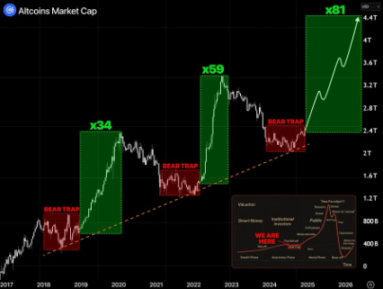
1. Why do we always want “someone to be responsible”?
After every sharp fluctuation, the market is eager to find a “reason”:
Is it a certain political figure
Is it a certain country
Is it an institution, fund, or exchange
Is it breaking news or a policy shift
The essence of this is not to understand the market, but to alleviate the anxiety brought by uncertainty.
When chaos is explained as “caused by someone,” the human brain produces a false sense of security:
At least this is something that can be understood and controlled.
But the market has never been a simple cause-and-effect system.
It does not “obey any one person,” nor does it operate according to a single logic.
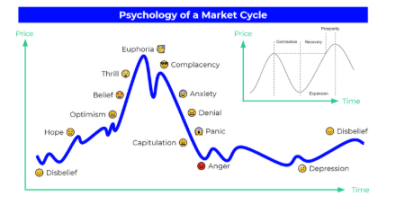
2. The market does not react to the event itself
What the market truly reacts to is not the event, but:
The emotional changes of people after the event occurs.
News is just a trigger
Emotion is the fuel
When prices rise, most people actually feel uneasy and are afraid to enter;
When prices fall, most people are afraid to keep holding and are eager to exit.
This is the most classic and counterintuitive paradox in market cycles.
3. The market is essentially a “collective nervous system”
In abstract terms, the market is more like a huge neural network, composed of countless participants, driven by two primal impulses:
Fear of Missing Out (FOMO): fear of missing opportunities
Fear of Losing Out (FOLO): fear of losing everything
Almost all price fluctuations are the alternating amplification of these two emotions at different stages.
All other information, opinions, and analyses are mostly just noise.
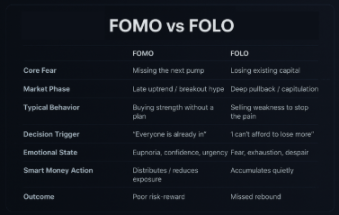
4. Why do most people always buy at the top and sell at the bottom?
In a bull market:
The brain interprets “rising” as safety
Risk is underestimated
People are more willing to buy at high prices
In a bear market:
The brain interprets “falling” as a threat
Risk is overestimated
People sell at the very moment they shouldn’t
This is exactly why most traders repeatedly make the same mistakes, and each time firmly believe:
“This time is different.”
5. Retail investors and “smart money” are never in sync
Observing the market, you’ll find a long-standing pattern:
Retail investors: enter when confidence is highest, exit when pain is deepest
Smart money: build positions during panic, exit during euphoria
These two behaviors almost never occur at the same time.
And it is precisely this time difference that constitutes a stable source of profit in the market.
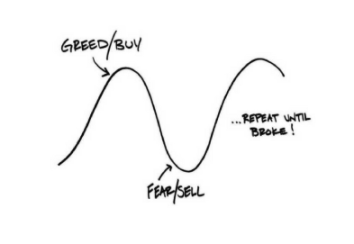
6. The only truly effective “indicator” is public sentiment
If you want to gain an edge, try observing the opposite:
When everyone is talking about a “certain uptrend”
When the market is full of confidence, optimism, and certainty narratives
This often means:
Risk is accumulating, and a top is forming.
And when the market is quiet, desperate, and no one is discussing the future,
It is instead the stage where risk has been fully released.
7. Overconfidence in your own judgment is itself a trap
Another common misconception is:
Constantly seeking “proof of correctness” for your own positions.
Once you start focusing only on information that supports your view, you are already in dangerous territory.
Mature traders do not pursue “truth,” but rather seek:
Imbalance between emotion and position.
Because profits are often born where consensus has not yet been reached by the majority.
8. Don’t try to predict every step, but understand the current stage
The market is not composed of countless independent events,
But operates within emotional cycles.
More important than predicting the next piece of news is the question:
Right now, are most people fearful or excited?
If you understand this, you are already ahead of those chasing news and predictions.
Because emotions always precede events.
9. Learn to distinguish between “noise” and “signal”
Noise: social media, emotional opinions, short-term predictions, group chat panic
Signal: liquidity changes, large capital positions, price action itself
When you learn to ignore noise and only observe signals,
You will begin to view the market from a perspective closer to that of institutions.
10. The market is not a knowledge game, but a patience game
The market does not reward those who react the fastest,
But those who can wait the longest.
Don’t look for the “perfect entry point,”
But look for a psychological edge.
When others chase news, you focus on emotions;
When others are eager to act, you choose to wait.
Conclusion:
The market is never driven by any one person, news, or event.
It is a collective psychological system driven alternately by fear and greed.
The reason most people fail is not a lack of information, but excessive emotional involvement.
Those who truly achieve stable profits do not understand “what will happen in the market,”
But rather—under what emotions people will make mistakes.
When you stop chasing explanations and start observing psychology,
The market will no longer be chaos to you, but repetition.
Disclaimer: The content of this article solely reflects the author's opinion and does not represent the platform in any capacity. This article is not intended to serve as a reference for making investment decisions.
You may also like
XRP sinks below $2 despite $1B in ETF inflows: How low can price go?

Beyond Trading: A Look at Star New Projects and Major Updates in the Solana Ecosystem
The Solana Breakpoint 2025 conference was truly spectacular.

Quick Look at the 33 Winning Projects of the Solana Breakpoint 2025 Hackathon
Over 9,000 participants formed teams and submitted 1,576 projects, with a total of 33 projects winning awards. All of them are top industry seed projects selected from hundreds.

WEEX Labs: The Next Chapter for Memecoin, the Era of Flash Trends
In the era of rapid trends, memecoins have begun to shift from being a "joke" to becoming a "cultural index."

Trending news
MoreCrypto prices
More





