
Google executive makes millions of dollars overnight through insider trading

Insider addresses manipulated Google's algorithm by referencing prediction market odds.
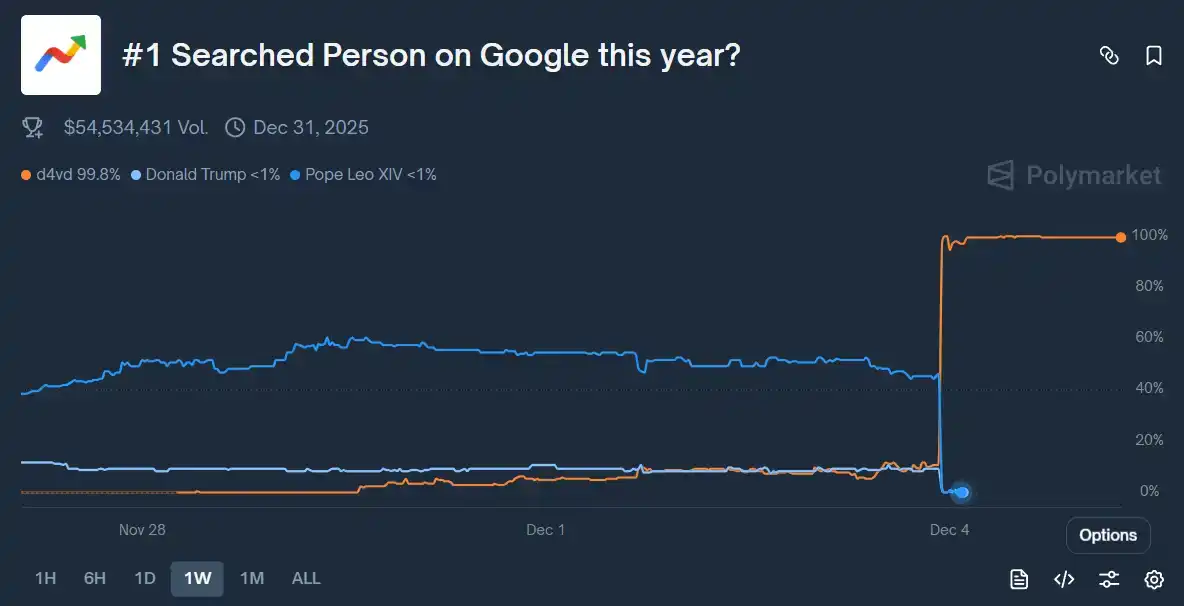
The hottest Polymarket event this week was undoubtedly yesterday’s sensational market: “Who will be the number one person in Google’s 2025 annual search ranking?” Since the market opened, Pope Leo XIV had always held the top spot, with his probability stably hovering around 50%. Meanwhile, global celebrities like Trump, Taylor Swift, and Musk dominated the market narrative—this was supposed to be a list of “celebrity contenders.”
Most traders never seriously looked at those near-zero-weight options at the bottom of the market: Mikey Madison, Andy Byron, d4vd... Their presence seemed only to make the odds table look richer; no one really considered them possible winners.
The “Foolish Whale” No One Cared About Goes Against the Trend
A week ago, while everyone focused on the fluctuations of these celebrity options, one address (0xafEe) bought a large position in “d4vd = Yes” at an extremely low price. In prediction markets, price equals probability—and at that time, d4vd’s probability was not just low, it was almost negligible.
To outsiders, this was just an insignificant “lottery position”: for such long-shot options with near-zero probability, a rise to 10% could bring dozens of times the return. The trader only invested about $20,000 in this position, while his historical trading volume was nearly $10 million, making the “lottery position” theory even more convincing.
The truly bizarre move happened a week later.
With no one knowing when Google would release the trending search list, this trader suddenly began building massive positions the day before yesterday. He didn’t buy “Yes” for the popular figures, but instead frantically swept up their “No” options.
Pope Leo XIV, Trump, Taylor Swift, New York’s new mayor... all the options the market considered “potential winners” were denied by him with millions of real dollars.
This kind of operation, with no hedging logic and ignoring price impact, completely defies whale trading logic and doesn’t even resemble normal investment behavior. Some in the market began to notice this contrarian whale, but most just saw him as a “fool with too much money.”
A Jaw-Dropping Market Reversal
However, just a few hours after he finished sweeping the orders, Google suddenly released its annual trending search list. The moment the rankings were announced, the entire market was collectively stunned—the top spot was neither the Pope, nor Trump, nor any other popular option, but that name with a long-term near-zero probability, the one traders couldn’t even be bothered to research: d4vd.
The market exploded instantly. In just a few seconds, d4vd’s probability shot vertically from the bottom of the chart to 99.9%, while all other options were instantly wiped out. As the market was still trying to figure out whether this was a Google system bug, some had already noticed: that “reckless” whale had made over a million dollars in profit in a single day.
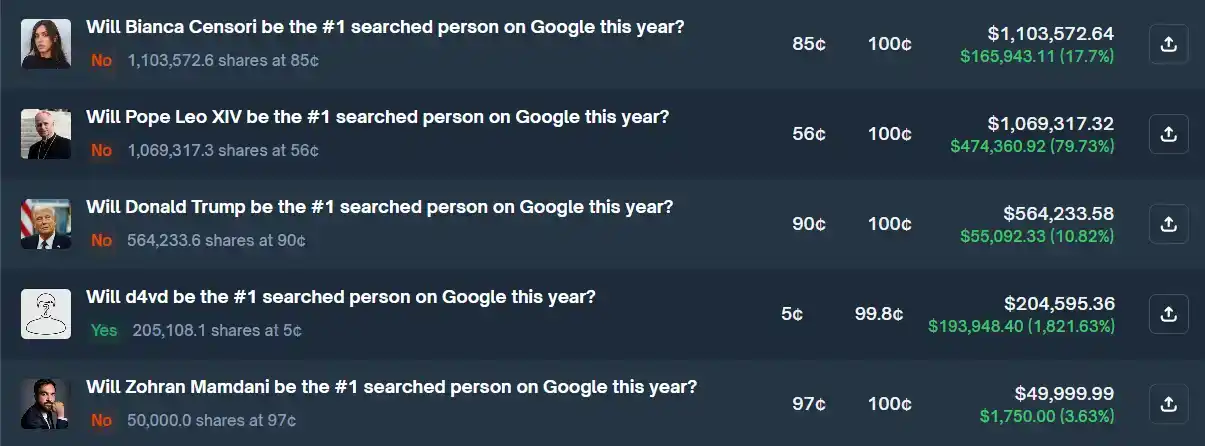
His “d4vd = Yes” bet won, yielding nearly 20 times the return. All his “No” bets on popular figures also won.
As people scrolled further down his positions, they found: in another almost identical market, “Google’s 2025 Annual Trending Search Top 5,” he also won across the board, investing nearly $500,000 in ten positions with a floating profit of $292,000. He also participated in seven markets regarding the release time of the new Gemini version, investing over $1 million, and again profited from all of them.
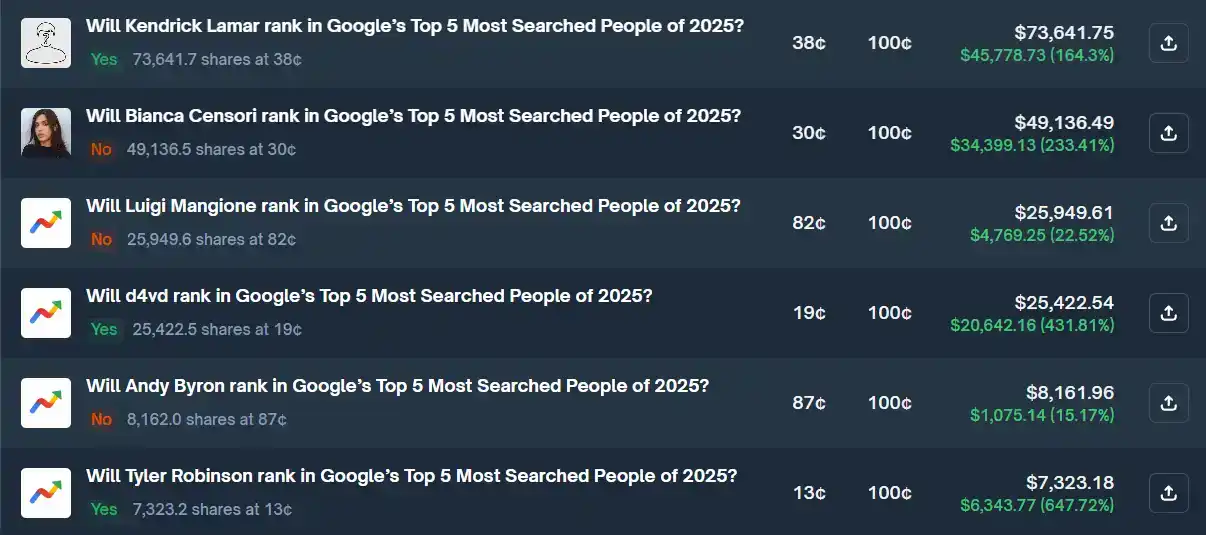
In other words, as long as it was related to Google, he seemed to never bet wrong.
Scarier Than Insider Trading: The “Rewriter”
When people began to label this as a case of a Google insider profiting from information asymmetry, deeper on-chain tracking pushed the incident in an even more unsettling direction. Analysis showed the trader’s address was adorableraccoon.eth, and according to on-chain records, he had staked over $15 million in ETH on Aave before November 4.
With on-chain assets alone exceeding $15 million, this is clearly not the wealth level of an ordinary Google employee. More and more signs indicate that this person is likely not just a regular engineer, but someone deeply embedded in Google’s core system, possibly even a high-level executive with decision-making power.
This brings an even more dangerous question to the surface: what if he not only knew the results in advance, but could even manipulate them?
Google’s annual trending search list is not determined solely by total search volume, but relies on an internal algorithm highly sensitive to sudden search spikes. In theory, as long as one knows the algorithm’s parameters, weights, and thresholds, it’s easy to push a name to “soar” in the rankings. For a Google executive with real authority, making a name skyrocket to the top is not an impossible task. In this framework, prediction markets are not tools for forecasting the future, but instruments for certain people to use their position to directly manufacture arbitrage opportunities through a hidden decision chain.
If this wealthy Google executive truly has the ability to tweak the algorithm, then all Google-related prediction markets are not just channels for him to profit from information asymmetry; if he wishes, he can even “fine-tune” the world line just like fine-tuning an algorithm, pushing it in the direction most favorable to himself.
Conclusion
For the first time, a person with core decision-making power has demonstrated in the open market that he can turn prediction markets from “platforms for settling information asymmetry” into “tools for altering reality.”
Prediction markets have always been seen as price mechanisms driven by collective wisdom to seek the truth in reverse; but in this incident, it was proven for the first time that they can be used by those with system privileges to rewrite the world line.
He’s not just betting on the future—he’s betting on the future he can create.
Disclaimer: The content of this article solely reflects the author's opinion and does not represent the platform in any capacity. This article is not intended to serve as a reference for making investment decisions.
You may also like
Ripple News: Franklin Templeton Says XRP Is Entering Its ‘Institutional Breakout Phase’
Exclusive: Expert Says ETF Calm Won’t Last Forever; Crypto Is Simply Maturing
Ethereum Breaks Against Bitcoin—Has the Crypto Rotation Begun?
Is Bitcoin’s security budget in jeopardy?

Trending news
MoreCrypto prices
More





