一、Project Introduction
Stable is a Layer 1 blockchain project supported by Bitfinex and
Tether, aiming to build a global stablecoin payment and settlement infrastructure optimized for USDT. The project seeks to eliminate the complexity of traditional blockchain gas fees and friction from cross-chain operations, using USDT as the native gas and settlement asset, supporting free P2P transfers, and achieving sub-second transaction finality.
Stable adopts an EVM-compatible architecture, providing a high-performance execution environment and embedding USDT liquidity into network consensus and governance, avoiding reliance on volatile tokens. Unlike general-purpose L1s such as
Ethereum, Stable focuses on stablecoin scenarios, requiring no additional token fees, and enhances its functionality with USDT-native and compliance features, including asset freezing mechanisms. In the Stable ecosystem, there are three main token/asset roles:
USST — Stablecoin (USD-pegged), representing principal;
YLD — NFT certificate representing interest generated by underlying assets, allowing holders to claim yield as specified;
STABLE — Governance token used for protocol governance, revenue distribution, and incentive mechanisms.
With this design, Stable aims to provide a solution that offers both stablecoin liquidity for DeFi and the yield of traditional financial assets, distinguishing it from simple 1:1 collateralized or algorithmic stablecoins.
Stable’s core model is to allow staking of STABLE tokens to receive protocol revenue in USDT, derived from on-chain transaction gas fees, managed by a smart contract treasury, and distributed proportionally to stakers.
Currently, Stable’s total deposit scale is: Phase 1 raised approximately $825 million; Phase 2 targeted $500 million, actually raising about $753 million; in total, over $1.5 billion, attracting around 19,000 users.
二、Project Highlights
Yield and Liquidity Separation (Yield-Splitting)
Users can deposit RWA collateral and separate principal and yield: principal is converted to USST, while the yield is represented by YLD and retained. This maintains liquidity while preserving yield. Compared to traditional stablecoins, STBL returns yield rights to minters, collateral providers, and users.
Collateral Based on Real-World Assets (RWA)
High-quality tokenized real-world assets (such as US Treasuries, money market funds, etc.) are used as collateral. Compared to purely crypto-collateralized models, this reduces volatility and increases stability, which is particularly relevant given current trends of integrating crypto and traditional finance, especially in regulated institutional channels.
Governance, Value Recirculation, and Incentive Mechanisms
STBL serves as a governance token, allowing holders to vote on key protocol parameters. The protocol generates revenue through USST mint/burn and YLD fees, returning it to STBL holders via buybacks, burns, and Multi-Factor Staking rewards. This design links protocol usage/adoption to token value.
三、Market Cap Comparison / Similar Projects
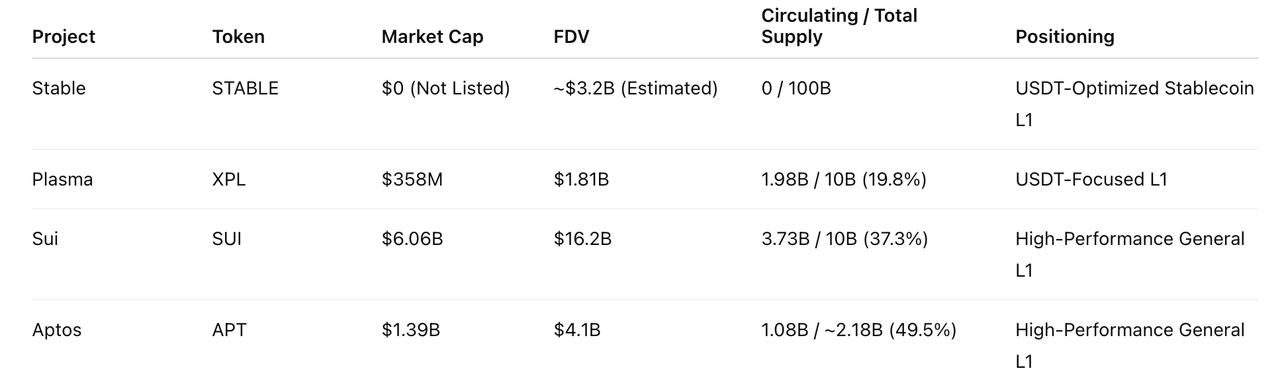
Stable’s
pre-market price is estimated at $0.032, with an FDV of approximately $3.2 billion, between Plasma and Aptos. Compared to general-purpose L1s (Sui/Aptos), Stable focuses on the stablecoin payment niche, most directly comparable to Plasma, but benefits from stronger institutional support ($1.1B pre-deposit vs. Plasma’s lower TVL). The large pre-deposit prior to mainnet launch indicates demand, but actual market performance depends on execution and adoption after TGE.
四、Economic Model (
Token
Distribution, Unlock, and Use)
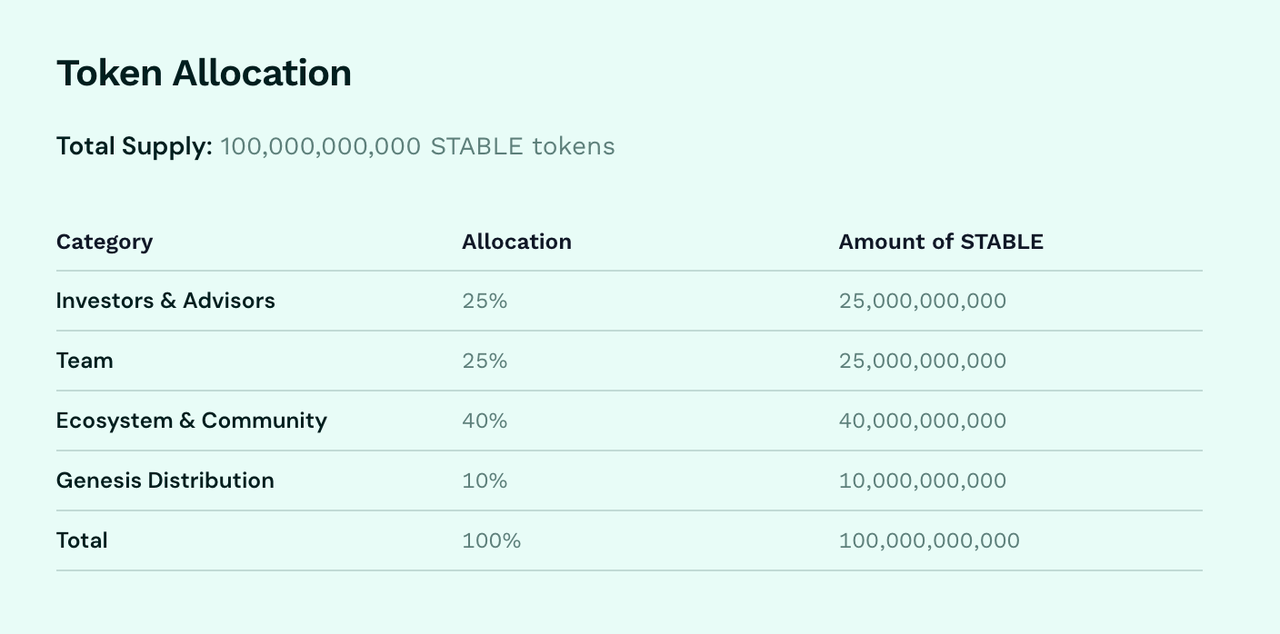
Total supply: 100 billion tokens, with 1.8 billion initially circulating. Distribution is as follows:
Investors: 25%, 1-year lockup + 36 months linear release, allocated to strategic investors and advisors for strategic investment and promotion;
Team: 25%, same 1-year lockup + 36 months linear release, allocated to core members, engineers, and contributors;
Ecosystem community incentives: 40%, 8% released at TGE, for ecosystem and community development;
Airdrop: 10%, 10% released at TGE, for initial liquidity, community activation, and events.
Core token functions:
Governance and decision-making — token holders participate in protocol upgrades and parameter adjustments;
Ecosystem incentives — rewards for developers, ecosystem participants, and community contributors;
Network security — staking enhances consensus security and decentralization;
Value capture — fees distributed as network revenue
五、Core Team
The team has approximately 40 full-time members across tech, product, design, BD, and marketing:
CEO: Matthew Tabbiner — former VC partner, co-founder of Bonzai AI
CTO: Sam Kazemian — founder of Frax Protocol and Everipedia
CFO: Brian Mehler — former VP at Block.one VC, managing $1B funds
COO: Thibault Reichelt — lawyer with cross-border operations experience
Technical team members come from B-Harvest, Crescent, Tendermint, Evmos, Samsung, LG, etc.
六、Project Financing
Stable has completed $28 million in seed funding at a valuation of $285 million, led by Bitfinex and Hack VC, with participation from Franklin Templeton and Castle Island Ventures. Angel investors include Tether CEO Paolo Ardoino and Braintree founder Bryan Johnson.
七、Risk Analysis
Token Selling Pressure
STBL tokens will release 18B at TGE (December 8, 2025), accounting for 18% of initial circulation, mainly for genesis and ecosystem unlocks, with no immediate team or investor selling pressure. Team and investor tokens will begin linear release after the 1-year cliff in December 2026, about 1.04B STABLE per month, totaling 82B by 2030. Short-term risk is low, but mid-term (2026–2027) may create market pressure. Linear release, 1-year cliff, and staking incentives mitigate risk, though low-cost investors and poor mainnet performance may increase selling pressure.
Initial secondary market launch may experience some price consolidation due to selling pressure.
Market Competition
Direct competition comes from Plasma (Bitfinex-backed), which has first-mover advantage; indirect competition includes Ethereum L2s (Optimism, Arbitrum),
Solana high-TPS networks, and traditional payment channels (Visa/Mastercard,
Ripple). STBL’s advantages include strong funding, PayPal cooperation, and USDT-native gas optimization, but the ecosystem starts from zero and must attract DApps and users, so differentiation needs market validation.
八、Official Links
Disclaimer: This report is AI-generated and does not constitute investment advice.