
Why Smart Investors No Longer Trust US CPI

US CPI data relied on 36% estimates in August, sparking concerns over inflation accuracy and Federal Reserve policy.
The reliability of US inflation statistics is under heightened scrutiny after it emerged that more than one-third of the August Consumer Price Index (CPI) relied on estimated rather than observed prices.
Economists warn that the growing use of imputed data threatens the credibility of a key benchmark for Federal Reserve policy and investor expectations.
More CPI Prices Are Now “Best Guesses”
The share of estimated prices in the US CPI climbed to 36% in August 2025, according to figures highlighted by market commentary outlet The Kobeissi Letter and confirmed by Bureau of Labor Statistics (BLS) methodology. That is up from 32% in July and represents the highest proportion since the BLS began tracking the metric.
Ordinarily, the CPI is compiled from about 90,000 monthly price quotes across roughly 200 categories of goods and services collected by several hundred field staff in 75 urban areas. When price data is missing, the BLS uses a “different-cell imputation” technique to fill gaps, drawing on related categories or comparable items. Historically, only about 10% of the index required such estimation.
However, since the second half of 2024, reliance on imputation has risen sharply, surpassing 30% throughout 2025. Analysts attribute the increase to pandemic-related data collection challenges, shifting consumption patterns, and difficulty obtaining timely quotes for volatile categories like housing and medical services.
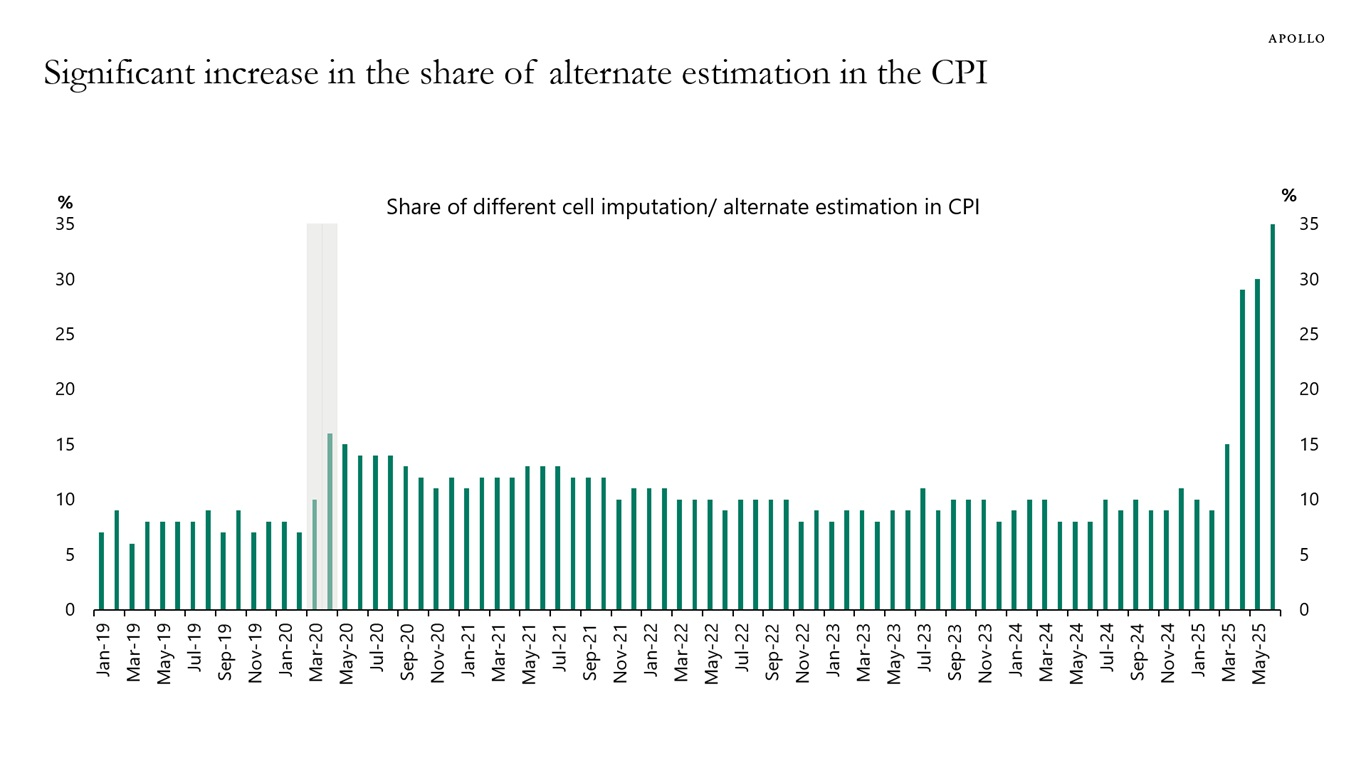 Significant increase in the share of alternate estimation in the CPI Sources:
BLS, Apollo Chief Economist
Significant increase in the share of alternate estimation in the CPI Sources:
BLS, Apollo Chief Economist
Markets Eye Fed Policy amid Data Questions
The CPI is the Federal Reserve’s primary gauge of consumer inflation and a cornerstone for interest rates and monetary policy decisions. A widening divergence between perceived household price pressures and official data could complicate the Fed’s inflation-targeting strategy and erode public confidence in its policy signals.
“Markets rely on CPI for a clear read on inflation,” said one independent economist. “If more than a third of the index is based on estimates, that introduces noise and raises questions about how accurately the data reflects real consumer costs.”
Investors already on edge over the Fed’s next moves may become more volatile if doubts about CPI accuracy persist. Bond markets, in particular, could see sharper reactions to CPI releases if traders suspect that headline figures understate actual inflationary trends.
Pressure Builds for BLS Transparency
Economists and market participants are urging the BLS to provide more detail on which CPI components rely on imputed data and how those estimates are derived. While imputation is a standard statistical practice, the scale of its current use has surprised many observers and underscores the need for robust disclosure.
For now, the BLS maintains that its procedures meet established statistical standards. Still, with the proportion of estimated prices at record levels, pressure is mounting for the agency to bolster confidence in one of the world’s most closely watched economic indicators.
Disclaimer: The content of this article solely reflects the author's opinion and does not represent the platform in any capacity. This article is not intended to serve as a reference for making investment decisions.
You may also like
Ripple CEO Projects Bitcoin Could Reach $180,000 by End of 2026

Solana Mobile Launches SKR Token to Power Seeker Ecosystem Security

BlackRock’s Larry Fink Admits Bitcoin Misjudgment, Cites $70B ETF Success as Proof

Ethereum Fusaka Upgrade Goes Live, Boosting Scalability Toward Instant Transactions

Trending news
MoreCrypto prices
More






