Zero-knowledge proofs (ZK-proofs) let validators confirm the origin or validity of crypto funds without revealing private transaction details, enabling privacy-preserving compliance that can satisfy law enforcement and protect user anonymity in on-chain and off-chain cash-out scenarios.
-
ZK-proofs verify facts without exposing private data, balancing privacy and compliance.
-
ZK-proofs can be used for financial confirmations, identity assertions, and regulatory checks.
-
Recent analyses by a16z Crypto and remarks from regulators highlight practicality gains and mainstream use cases.
Zero-knowledge proofs: how ZK-proofs protect crypto privacy while enabling compliance checks. Read expert analysis and practical implications — learn what this means for users and regulators.
A16z Crypto’s analysis follows the Tornado Cash verdict and argues that zero-knowledge proofs can preserve privacy while enabling law enforcement to verify the legitimacy of funds without exposing transaction-level details.
The crypto-focused investment arm of Andreessen Horowitz, a16z Crypto, says modern cryptographic methods like zero-knowledge proofs can both protect user privacy and allow compliance checks that differentiate legitimate activity from criminal proceeds.
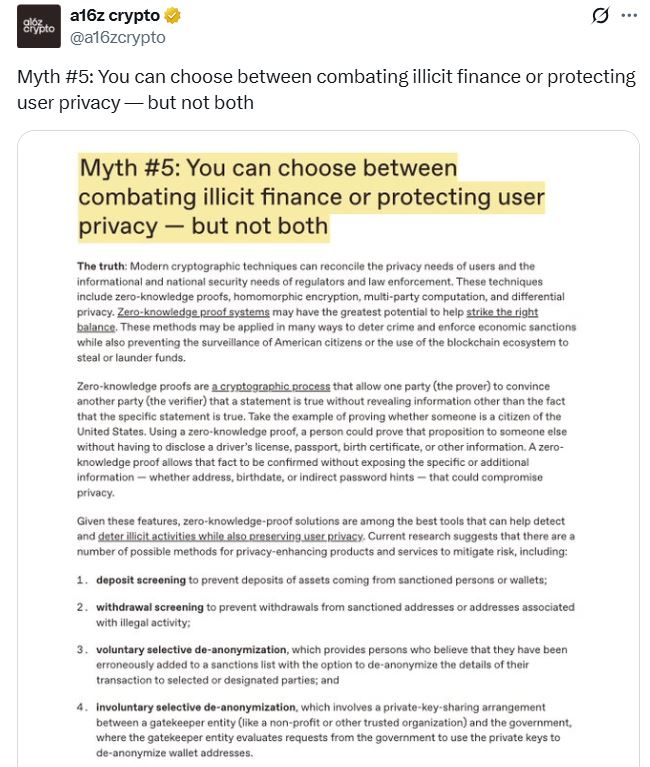
In a report published on Tuesday, a16z Crypto policy partner Aiden Slaven and regulatory counsel David Sverdlov called ZK-proofs the “greatest potential” solution for proving the origin of funds without publicly revealing private transaction data.
The report was issued weeks after Roman Storm, co-founder of the mixing service Tornado Cash, was found guilty on charges related to running an unlicensed money transmission business. Prosecutors argued mixing services can obscure illicit proceeds and impede investigations.
Slaven and Sverdlov wrote that if users can present cryptographic proofs at cash-out points, those venues could have reasonable assurance that funds are not proceeds of crime while users retain on-chain privacy.
 Source: a16z Crypto
What are zero-knowledge proofs and how do they work?
Zero-knowledge proofs are cryptographic methods that let one party prove the truth of a statement to another party without revealing the underlying data. They verify authenticity—such as the lawful origin of funds—while keeping transaction details private and unreadable to third parties.
How can ZK-proofs help law enforcement and compliance?
ZK-proofs enable conditional verification: exchanges or cash-out services can confirm that crypto does not derive from illicit activity without seeing full transaction histories. a16z Crypto’s authors Aiden Slaven and David Sverdlov argue this reduces friction between privacy advocates and regulators.
Regulatory conversations, including remarks by SEC Commissioner Hester Peirce and the US government’s July crypto report, acknowledge ZK-proofs as a compliance-friendly privacy tool. Financial institutions such as JPMorgan are exploring similar cryptography in private ledgers for secure settlement use cases.
Why are privacy technologies becoming practical for mainstream use?
Improvements in efficiency and scalability have lowered computational costs for ZK-proofs, making them feasible for larger systems. Cryptographers and engineers are optimizing proof generation and verification, narrowing the gap between experimental projects and production-grade deployments.
Beyond finance, ZK-proofs can support identity assertions—proving citizenship or age without handing over documents—or protect aggregated datasets through techniques like differential privacy and multiparty computation.
What other cryptographic tools complement ZK-proofs?
Alternatives and complements include homomorphic encryption, which allows computations on encrypted data; multiparty computation, enabling joint computation without data exposure; and differential privacy for safe aggregate analytics. Each approach serves distinct threat models and regulatory needs.
How can organizations adopt ZK-proofs responsibly?
Adoption requires clear standards, interoperable tooling, and collaboration between technologists and regulators. Pilot programs at regulated cash-out points and bank-operated ledgers can validate that proof-based checks meet compliance without eroding privacy.
Frequently Asked Questions
Can zero-knowledge proofs prove funds are clean without revealing transactions?
Yes. ZK-proofs can demonstrate that a set of transactions satisfies compliance criteria without exposing transaction-level data, letting cash-out points verify legitimacy while preserving user anonymity.
Do ZK-proofs solve all privacy and compliance issues?
No. ZK-proofs address specific verification needs but must be combined with governance, identity safeguards, and anti-money-laundering policies to form a comprehensive compliance framework.
Key Takeaways
- ZK-proofs balance privacy and compliance: They verify facts without disclosing private data.
- Practicality is improving: Scalability and usability gains make mainstream use more achievable.
- Multiple tools matter: Homomorphic encryption, MPC, and differential privacy complement ZK-proofs depending on the use case.
Conclusion
Zero-knowledge proofs offer a promising path for reconciling user privacy with regulatory needs. As cryptographic performance improves and pilot deployments expand, ZK-proofs could become a standard compliance tool that preserves anonymity while enabling lawful oversight. Stay informed through COINOTAG coverage for updates and practical guidance.