
Bitcoin price tracking ahead of the past 2 halvings — now 3 months to go

If you expected spot ETFs to pump the price of bitcoin, chances are you’ll love what the halving is meant to do
Bitcoin ETFs haven’t yet summoned a tidal wave of fresh capital to crypto markets, but fret not. The next supposed price catalyst, the bitcoin halving, is right around the corner.
Legend has it that bitcoin halvings are monstrously bullish. After all, the last three bull markets each began roaring only a few months after each event.
There have only been three halvings in Bitcoin’s history, in 2012, 2016 and 2020, and three is far too small a sample size from which to draw any meaningful conclusion.
Still, fewer bitcoins released each day will lead to a supply crunch, believers would say, inevitably pushing bitcoin ( BTC ) skyhigh.
Truth is, nobody really knows what will happen around the halving, but it’s the bitcoin miners who will feel its immediate effects.
Bitcoin distributes all new bitcoins directly to miners, who in about three months (around April 19) will suddenly earn 50% fewer block rewards: 3.125 BTC ($135,000) per block down from 6.25 BTC ($270,000).
- Bitcoin self-regulates the time between blocks, keeping it around 10 minutes on average.
- Miners usually solve 144 blocks in a 24-hour period, which won’t change after the halving.
- Block rewards currently add up to 900 BTC ($38.9 million) each day.
Miners can sell the bitcoin they earn to cover overheads (mostly electricity and in some cases debt ). Bitcoin users also pad out block rewards with transaction fees, and thanks to the popularity of Ordinals inscriptions , they’re forking out more than ever to use the network.
Users altogether paid about $500,000 per day in October but as much as $24 million in December, although miners have earned under $10 million per day in January so far.
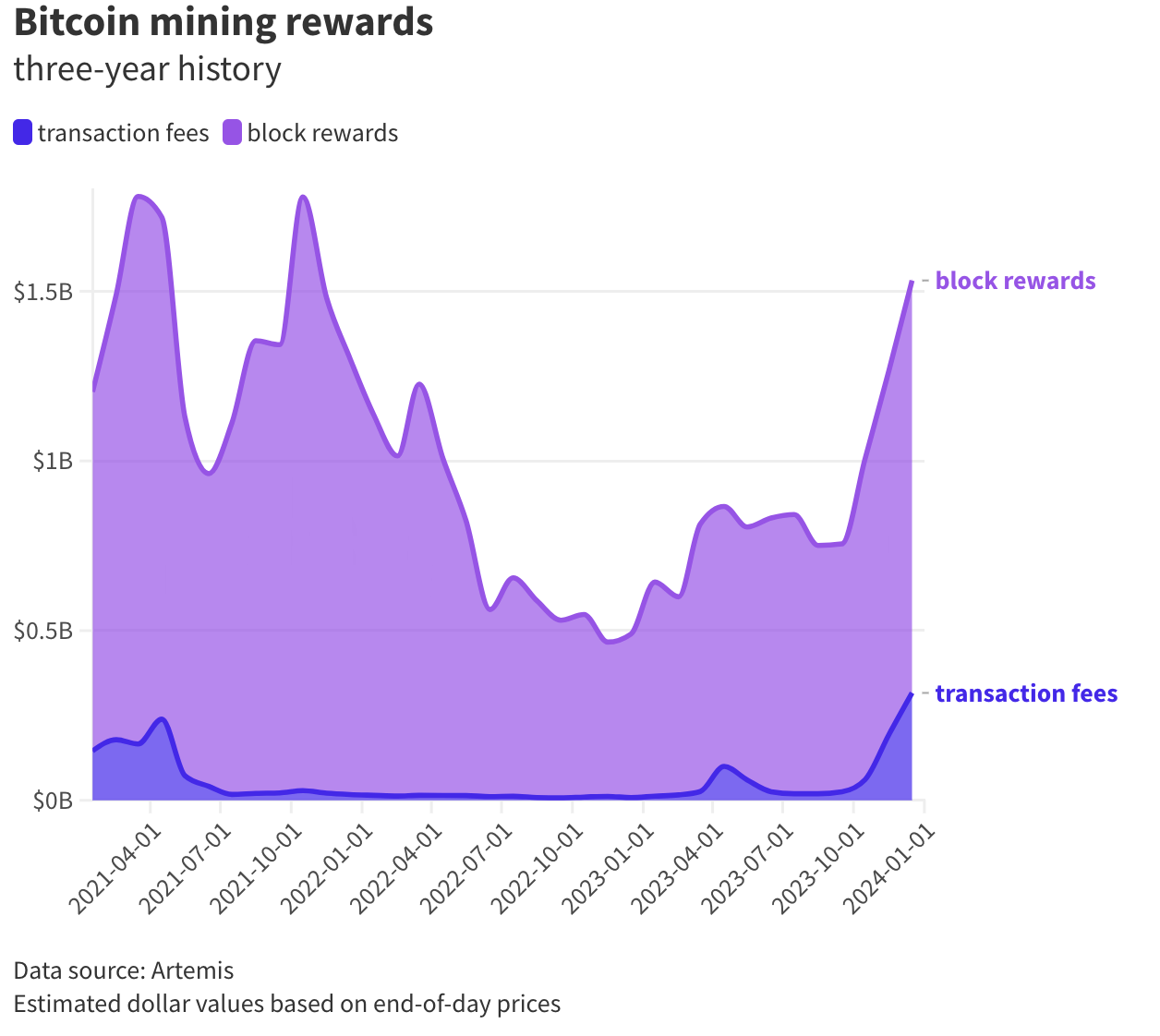
That still works out to be about half the block rewards up for grabs after April 19. But bitcoin’s price would need to stay about the same until then, alongside consistent demand for inscriptions.
Bitcoin staying up would solve halving concerns
All this makes bitcoin’s price a very sensitive issue for the network .
It’s always possible that the price of bitcoin could drop so low that it would force miners to switch off their rigs lest they run at a loss — a common occurrence throughout the last two bear markets, leading to debt raises and a string of bankruptcies .
One estimate from Glassnode last September suggested that bitcoin dropping to $30,200 would “likely put the majority of the mining market into severe income stress.” Bitcoin trades for $43,000 right now, which would mean bitcoin miners could hypothetically withstand a 30% drop in bitcoin’s price around the next halving .
Glassnode’s calculation was done weeks before Ordinals inspired a gigantic boom in fees, so it’s likely miners will have more breathing room than first anticipated.
(There’s also far more hashrate on the Bitcoin network than ever before and its overall security is unlikely to be significantly impacted even if a large percentage of miners were to be switched off for any reason.)
Block rewards are paid in bitcoin and are unaffected by its US dollar value. So, the opposite scenario, in which the price of bitcoin pumps significantly around the halving is, of course, much better for miners and everyone else.
Any concerns over whether block rewards will be enough to keep miners afloat after the halving could be properly put to bed if bitcoin’s price were to simply double.
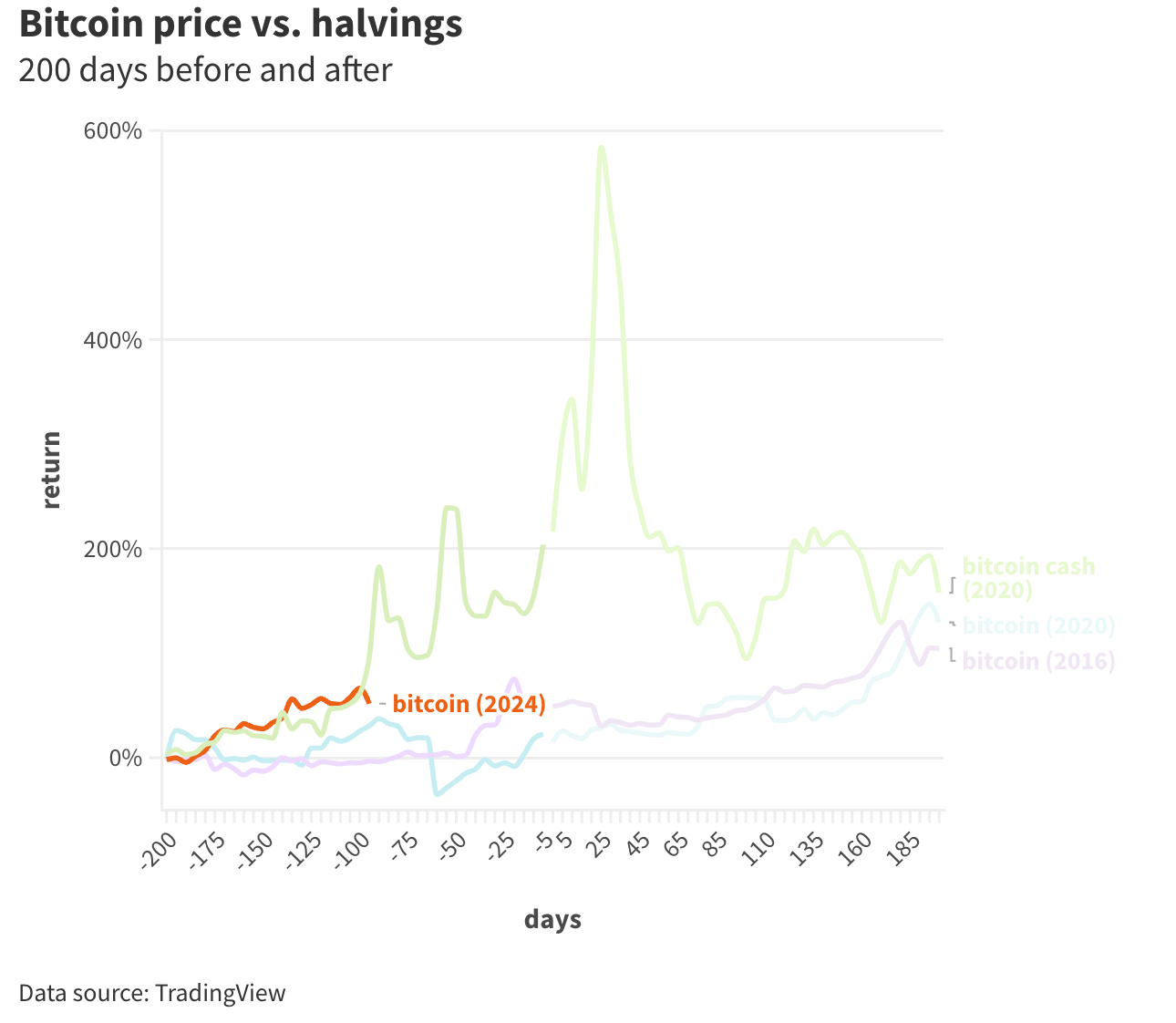
So far, so good. Tracking prices 200 days out from the past three bitcoin halvings shows BTC already rallying by 50% until now, largely propelled by buzz around BlackRock and others’ bitcoin ETF bids.
That’s better than the lead up to the past two halvings. Bitcoin had jumped by less than one third by this point before the 2020 halving, and in 2016, bitcoin had fallen 3%.
Bitcoin’s performance around the first halving in 2012 blows the others out of the water. BTC rallied nearly 150% in the 200 days leading up to the event. Including the 200 days after stretches that number up to 4,500%.
Bitcoin is just as likely to map how its biggest fork, bitcoin cash ( BCH ), performed around its own halving.
BCH tripled in the 200 days leading up to it and tripled again in the month after — but would go on to collapse by two-thirds over the following weeks.
Disclaimer: The content of this article solely reflects the author's opinion and does not represent the platform in any capacity. This article is not intended to serve as a reference for making investment decisions.
You may also like
Stablecoin Legislation Booms Globally, Why Is China Taking the Opposite Approach? An Article to Understand the Real National Strategic Choices
Amid the global surge in stablecoin legislation, China has chosen to firmly curb stablecoins and other virtual currencies, while accelerating the development of the digital yuan to safeguard national security and monetary sovereignty. Summary generated by Mars AI. This summary is produced by the Mars AI model and its accuracy and completeness are still being iteratively improved.
Liquidity migration begins! Japan becomes the Fed's "reservoir," 120 billions in carry trade returns set to ignite the December crypto market
The Federal Reserve has stopped quantitative tightening and may cut interest rates, while the Bank of Japan plans to raise rates, changing the global liquidity landscape and impacting carry trades and asset pricing. Summary generated by Mars AI. This summary is produced by the Mars AI model, and the accuracy and completeness of its content are still under iterative improvement.
Weekly Hot Picks: Bank of Japan Sends Strongest Rate Hike Signal! Is the Copper Market Entering a Supercycle Rehearsal?
The leading candidate for Federal Reserve Chair is being questioned for potentially "accommodative rate cuts." Copper prices have reached a historic high, and a five-hour meeting between the United States and Russia ended without results. Expectations for a Japanese interest rate hike in December have surged, and Moore Threads' stock soared more than fivefold on its first day... What market moves did you miss this week?
Monad Practical Guide: Welcome to a New Architecture and High-Performance Development Ecosystem
This article will introduce some resources to help you better understand Monad and start developing.
Trending news
MoreCrypto prices
More





