JPMorgan launches a $50M issuance on Solana settled in USDC
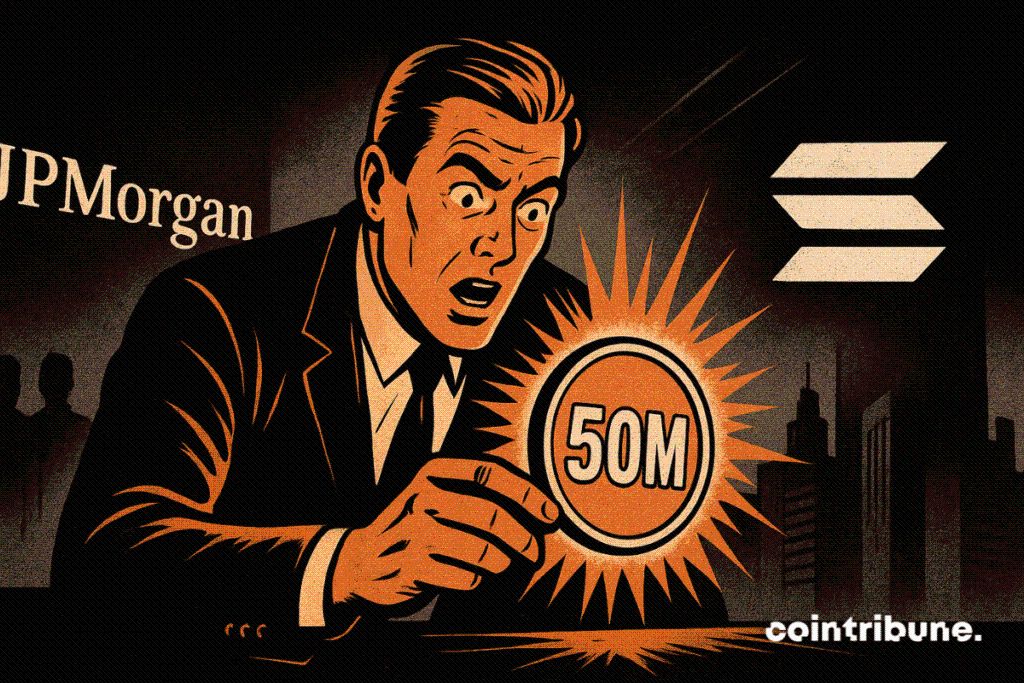
JPMorgan, one of the largest American banks, has just completed a historic transaction: a 50 million dollar commercial paper fully managed on the Solana blockchain. Galaxy Digital, Coinbase, and Franklin Templeton participated in this pioneering operation settled in USDC .
In brief
- JPMorgan issued and settled a 50 million dollar commercial paper for Galaxy Digital on the Solana blockchain using USDC.
- Coinbase and Franklin Templeton acquired this tokenized debt with custody and settlement directly on-chain.
- This operation represents one of the first times a major American bank manages a financial instrument via a public blockchain.
- JPMorgan plans to extend this model to other types of securities and investors starting in 2026.
JPMorgan crosses a historic milestone with a $50M debt issuance on Solana
JPMorgan has just crossed a line that few dared to imagine just a few years ago. The bank issued a 50 million dollar commercial paper for Galaxy Digital Holdings directly on Solana.
The operation sets a precedent: all payments, from issuance to redemption, were settled in USDC , Circle’s stablecoin.
Coinbase Global and Franklin Templeton redeemed this short-term debt asset. The structure is entirely based on the blockchain, from initial payment to securities custody.
JPMorgan developed the USCP token to represent this claim, managing the entire issuance process without going through traditional channels.
Scott Lucas, head of digital asset markets at JPMorgan, confirmed the bank’s ambition.
Starting in the first half of 2026, the institution plans to integrate new investors, other types of issuances, and more categories of securities. According to him, institutions show growing interest in models combining digital settlement and short-term financing instruments.
For Galaxy Digital, this issuance is a first. Jason Urban, global head of trading, explains that the use of public blockchains aligns with the processes developed by the company for several years.
The blockchain structure allows access to a growing number of institutional investors who now integrate these tools into their portfolios.
The crypto ecosystem validates the institutionalization of the blockchain
Franklin Templeton sees this transaction as a strong signal of institutionalization. Sandy Kaul, head of innovation, emphasizes that each on-chain operation enriches the data and experience needed for the standardization of tokenized financial instruments. The goal: to transform what is still experimental into a market standard.
The Solana Foundation welcomes having served as a pillar for this issuance. Nick Ducoff, head of institutional growth, stresses the predictability of the execution environments offered by the network.
This technical stability reassures traditional players, who remain cautious about the perceived risks of public blockchains.
Coinbase played a dual role in the operation: investor and service provider. Brett Tejpaul, co-CEO of Coinbase Institutional, specifies that the company ensures custody and management of the portfolio for the USCP token, as well as entry and exit services for USDC. The commercial paper acquisition directly appears on Coinbase’s balance sheet, which manages the associated private key infrastructure.
This transaction takes place in a paradoxical context for JPMorgan. While the bank positions itself as a pioneer of tokenized finance, it faces accusations of “debanking” targeting pro-Trump crypto actors. Jamie Dimon recently denied any political witch-hunt , calling for a reform of compliance rules considered unclear.
In summary, JPMorgan announces it wants to extend this issuance model to other categories of securities and issuer profiles. The second phase will evaluate the application of similar structures to different investor bases. One thing is certain: the boundary between traditional finance and public blockchain is becoming increasingly porous.





