Written by: Ye Huiwen
Source: Wallstreetcn
Ethereum is carrying out a key network upgrade today called "Fusaka," marking another important milestone in its ongoing scaling roadmap. This upgrade aims to significantly increase data capacity and optimize protocol efficiency, further reducing transaction costs for Layer-2 networks and consolidating Ethereum's core position as a global, efficient settlement layer.
According to the plan, the Fusaka upgrade will be activated at block height 13,164,544 on December 3, 2025. This is a new step in Ethereum's scaling journey following the Dencun and Pectra upgrades. Kenny Lee, Head of Crypto at Goldman Sachs, pointed out that Fusaka represents the next stage in Ethereum's scalability roadmap, aiming to evolve the network into a settlement layer with both global influence and cost-effectiveness.
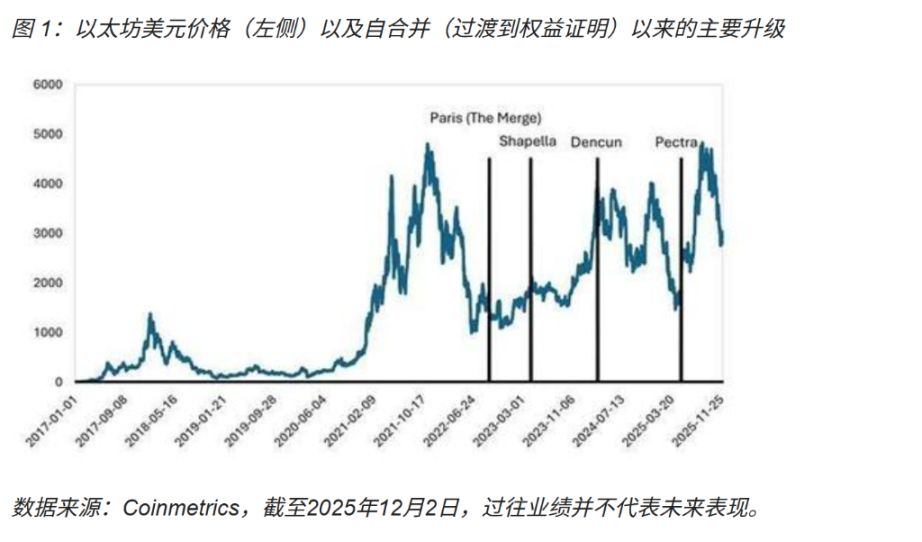
The core change in this upgrade is the introduction of "PeerDAS" (Peer Data Availability Sampling) technology. This feature is designed to theoretically increase Layer-2 network data capacity by 8 times, thereby achieving higher transaction throughput and is expected to significantly reduce transaction fees for Layer-2 users.
In addition, the Fusaka upgrade introduces a "Blob-Only Parameter" (BPO) fork mechanism, making future network capacity increases more flexible; it also optimizes Layer-1 mainnet performance through features such as storage expiry and block control, and improves wallet functionality and user experience. Together, these changes constitute a structural leap for Ethereum in scalability, sustainability, and operability.
From Dencun to Fusaka: Focusing on Scaling and Infrastructure Optimization
The Fusaka upgrade is actually the simultaneous activation of the consensus layer "Fulu" upgrade and the execution layer "Osaka" upgrade. According to the final plan confirmed by the Ethereum Foundation, the Ethereum Improvement Proposals (EIPs) included in the upgrade mainly focus on three major areas:
-
Improving Layer-1 Efficiency: Including storage expiry (EIP-7642) and transaction gas limit (EIP-7825), aiming to maintain node efficiency as network usage grows.
-
Expanding Layer-2 Data Capacity: The core is PeerDAS (EIP-7594), supplemented by blob parameter updates (EIP-7892) and blob fee optimization (EIP-7918).
-
Improving User Experience and Developer Tools: Covering deterministic proposer lookahead (EIP-7917) and precompilation support for the secp256r1 curve (EIP-7951), to enhance wallet functionality and application development.
These three directions are fully aligned with the strategic priorities established by the Ethereum Foundation in April 2025 (scaling the Ethereum mainnet, scaling blobs, improving user experience). This article will focus on the improvements to Layer-2 data capacity and fee mechanism optimization.
Core Mission: The "L2-Centric" Path to Scaling
To understand why Ethereum focuses on scaling through Layer-2, it is necessary to revisit its design philosophy.
In the "blockchain trilemma" (the impossibility of simultaneously achieving decentralization, security, and scalability), Ethereum's early design prioritized decentralization and security at its base layer (Layer-1). As a result, with the growing demand for decentralized applications, Layer-1 encountered bottlenecks of high transaction fees and slow confirmation times.
To solve this problem, Ethereum adopted a "rollup-centric" roadmap. This strategy shifts most transaction processing tasks to Layer-2 networks, where transactions are executed off-chain and then compressed data is published back to Ethereum Layer-1 for final settlement and security assurance.
This modular approach allows Ethereum to achieve scalability without sacrificing its core decentralization principles. However, it also introduces a new "data availability" problem—how to prove to the entire network that the published compressed data is valid without requiring every node to download all the data.
PeerDAS: The Key to Achieving 8x Data Capacity Growth
The most influential feature in the Fusaka upgrade, PeerDAS, was created precisely to solve the above data availability problem.
Before Fusaka, although the Dencun upgrade introduced "blobs" as a cost-effective Layer-2 data storage method, every Ethereum full node still had to download the complete blob data, which limited the network's bandwidth and throughput ceiling.
PeerDAS fundamentally changes this model. After the upgrade, the network will split blob data into small pieces and distribute them to different nodes. Each node only needs to download and verify a small portion of the total data (about 1/8), and can use cryptographic methods to ensure the availability and integrity of the entire dataset. This mechanism greatly reduces the resource requirements for individual nodes, theoretically bringing about an 8x increase in network data capacity. PeerDAS lays the foundation for subsequent blob scaling and is a key driver for reducing Layer-2 transaction costs.
BPO Fork: More Flexible Blob Limit Increases
With the continued growth of Layer-2 transaction activity (see Figure 2), demand for blob space is also rising.
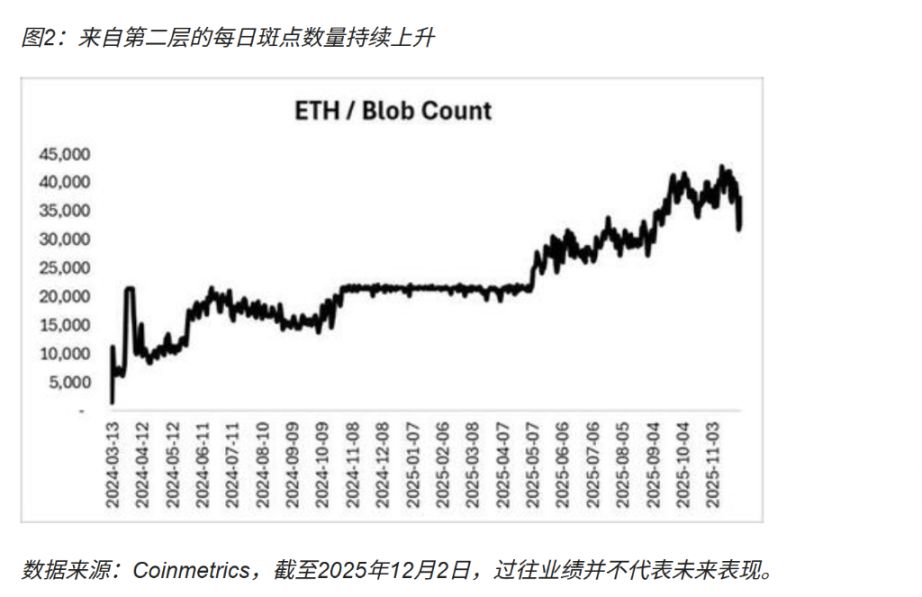
According to Coinmetrics data, the daily number of blobs is on an upward trend. However, under the current mechanism, increasing the number of blobs per block requires a complex "hard fork," which is difficult to coordinate and infrequent.
To address this bottleneck, Fusaka introduces the "Blob-Only Parameter (BPO) Fork" mechanism. This is a dedicated lightweight fork used only to update blob-related parameters (such as the maximum number of blobs per block). Because its scope is small and impact is controllable, development teams can deploy such upgrades more frequently and safely, allowing the network to gradually increase data capacity without waiting for major upgrades that include other features. According to the Ethereum Foundation, BPO forks will be pre-programmed to double the number of blobs in phases over several weeks until the maximum is reached.
Stable Fee Market: Introducing the Blob Floor Price Mechanism
After the Dencun upgrade, Layer-2s face two independent fees when publishing data to Ethereum: execution gas and blob gas. When blob demand is low, its fee may drop close to zero, but Layer-2s still have to pay potentially considerable execution gas. This "price signal failure" leads to inefficient pricing and market instability.
To solve this problem, Fusaka introduces a "floor price" mechanism for blobs through EIP-7918. This floor price is not a fixed value, but dynamically linked to execution gas fees.
When the market-driven blob fee falls below this floor price, the fee adjustment algorithm will prevent it from dropping further. This is intended to ensure that blob fees always reflect their economic value, keep the fee market sensitive to network congestion, and provide Layer-2s with a more stable and predictable pricing environment.
Market Impact and Potential Risks
The Fusaka upgrade is expected to have far-reaching market impact. The data capacity improvements brought by PeerDAS and BPO forks are likely to further reduce Layer-2 operating costs. Meanwhile, the floor price mechanism of EIP-7918 ensures that blob space is not used unreasonably cheaply, maintaining the network's economic sustainability. This may intensify competition among Layer-2 networks, with the focus of competition potentially shifting from transaction costs to user experience, ecosystem cooperation, and liquidity depth.
However, this upgrade also comes with some risks and considerations:
-
Execution risk: Any major hard fork carries the risk of client coordination failure or bugs, which could cause temporary network instability.
-
Limited impact on mainnet fees: The direct benefits of the upgrade are mainly reflected in Layer-2s, and Ethereum mainnet gas fees may not decrease immediately in the short term.
-
Hardware requirements: Although PeerDAS optimizes efficiency, higher blob targets may still increase validators' bandwidth requirements over time.
-
Delayed ecosystem adaptation: Layer-2 and dApp developers will need time to fully leverage the advantages of the new architecture.