
MMT Price Forecast Fluctuations: Changes in Institutional Outlook and Macroeconomic Drivers
- Mazda's stock volatility (2023-2025) stems from institutional investor caution and macroeconomic pressures like inflation, interest rates, and EV transition challenges. - Institutional ownership remains stable (16.8% by Master Trust Bank, 5.1% by Toyota), but firms like Morgan Stanley reduced stakes amid concerns over EV adaptation. - Strategic cost-cutting (85% lower EV investment) and repurposed production lines aim to mitigate risks, yet Q3 2025 showed 9% sales decline and ¥46.1B operating loss. - Div
Mazda Motor Corporation (MMT): Stock Volatility and Market Forces (2023–2025)
In recent years, Mazda Motor Corporation's (MMT) share price has experienced significant fluctuations, largely influenced by the actions of major institutional investors and broader economic trends. As of November 2025, the automotive industry continues to grapple with evolving regulations, inflationary pressures, and the accelerating shift toward electric vehicles (EVs). This overview explores the impact of institutional investor sentiment and macroeconomic developments on MMT’s stock performance from 2023 to 2025, providing perspective on its ongoing volatility.
Institutional Investors: Shifting Stakes and Strategic Responses
Key institutional stakeholders, including The Master Trust Bank of Japan, Ltd. (holding 16.8%) and Toyota Motor Corporation (with 5.1%), have maintained their positions in MMT as of March 31, 2025. Despite this stability among major shareholders, the broader institutional environment reflects a more cautious outlook. For example, Morgan Stanley & Co. LLC reduced its stake to 1.7%, signaling concerns about Mazda's readiness for the EV transition.
Institutional investors often serve as indicators of market confidence, and their strategies are closely tied to prevailing economic conditions. The recent rise in interest rates has led many institutions to favor liquidity and short-term investments over long-term, capital-heavy projects. This trend aligns with Mazda’s recent adoption of a “lean asset” approach, focusing on repurposing existing manufacturing lines for EV production instead of constructing new facilities. This move has been praised for reducing capital expenditures by 85%, helping to ease some investor apprehension about the risks of electrification.
However, mixed institutional sentiment persists. In the third quarter of 2025, Mazda reported a 9% drop in consolidated wholesale volume and an operating loss of ¥46.1 billion. These results highlight that while institutional investors remain engaged, their confidence is closely tied to Mazda’s ability to adapt to regulatory and market shifts.
Macroeconomic Influences: Inflation, Interest Rates, and EV Market Dynamics
Inflation and Cost Strategies
Rising inflation in Japan, particularly with food prices such as rice increasing by 49.1% year-over-year, has compelled Mazda to implement aggressive cost-saving measures. The company’s emphasis on utilizing existing infrastructure for EV production is a direct response to these inflationary challenges, helping to conserve capital. Nevertheless, this strategy may present scalability issues in the future, especially as global demand for EVs continues to grow.
Interest Rate Trends and Investment Decisions
Fluctuating global interest rates have added complexity to Mazda’s financial planning. While the U.S. Federal Reserve’s rate reductions in late 2024 and October 2025 have lowered borrowing costs, high auto loan rates still suppress consumer demand. In Europe, the European Central Bank (ECB) maintained its rates in October 2025, reflecting a cautious, data-driven approach. These varying monetary policies have resulted in a fragmented market: Mazda’s North American sales jumped 22% year-over-year in 2024, whereas European sales fell by 4%.

EV Sector Developments and Regulatory Challenges
The uneven expansion of the EV market has introduced additional uncertainty. Although global EV sales reached 17 million units in 2024, regional adoption rates vary. In the U.S. and Europe, elevated interest rates and policy changes, such as the removal of subsidies, have slowed EV uptake. Meanwhile, Mazda’s investment in a new Japanese facility for cylindrical lithium-ion batteries—intended for its first dedicated EV platform—demonstrates a long-term commitment to electrification. The outcome of this initiative will depend on regulatory clarity, especially as the U.S. imposes tariffs on Chinese EVs and Japan allocates $550 billion to mitigate these trade barriers.
Financial Results and Future Prospects
Mazda’s financial performance in late 2024 and into 2025 reflects the tension between strategic adaptation and external economic pressures. Despite a 4% annual increase in global sales (reaching 966,000 units), operating income dropped to ¥148.3 billion, and global sales volume declined by 3% in Q3 2025. These figures underscore the company’s vulnerability in an environment marked by high inflation and tariffs.
Looking forward, Mazda’s full-year sales projection of 1.33 million units is heavily dependent on the market reception of new models like the CX-80 and Mazda6e. However, institutional investors remain cautious. Potential interest rate hikes by the Bank of Japan and the ECB’s prudent stance suggest that access to capital may remain constrained, limiting Mazda’s ability to pursue aggressive EV expansion.
Summary: Steering Through Market Uncertainty
MMT’s share price volatility is shaped by both institutional investor sentiment and macroeconomic conditions. While major shareholders remain committed and Mazda has adopted cost-effective EV production strategies, concerns about scalability and regulatory risks persist. Divergent monetary policies across Japan, the U.S., and Europe have created a fragmented market, making Mazda’s performance uneven across regions.
- Key factors influencing future volatility:
- The speed of EV adoption in major markets
- The direction of global interest rates
- Mazda’s ability to balance cost management with long-term innovation
As of November 2025, MMT’s stock remains in a period of uncertainty, with institutional investors closely watching for signs of stability or further disruption.
Disclaimer: The content of this article solely reflects the author's opinion and does not represent the platform in any capacity. This article is not intended to serve as a reference for making investment decisions.
You may also like
ZEC Rises 8.55% Over 24 Hours as Significant Short Covering and Position Flips Occur
- ZEC surged 8.55% in 24 hours to $346.59, but fell 23.78% in 7 days amid volatile swings. - A major ZEC short position turned $21M loss into $5M+ profit after price declines in late October. - The same address holds ETH and MON shorts, with ETH shorts generating $9.5M gains (643% profit). - ZEC's 1-year 563% rise contrasts recent declines, highlighting liquidity-driven market risks for leveraged positions. - Analysts remain cautious as short-term gains coexist with uncertain long-term volatility in crypto

ALGO Climbs 5.83% as Recent Gains Counteract Overall Downtrend
- ALGO surged 5.83% in 24 hours on Dec 2, 2025, but remains down 58.74% annually amid broader crypto market declines. - Short-term buying interest drove the rally, though analysts warn of continued volatility due to macroeconomic uncertainties. - The 24-hour rebound contrasts with a 4.37% seven-day loss, highlighting uneven recovery in the crypto sector. - Traders remain cautious as isolated buying pressure emerges, but long-term bearish trends persist despite temporary optimism.
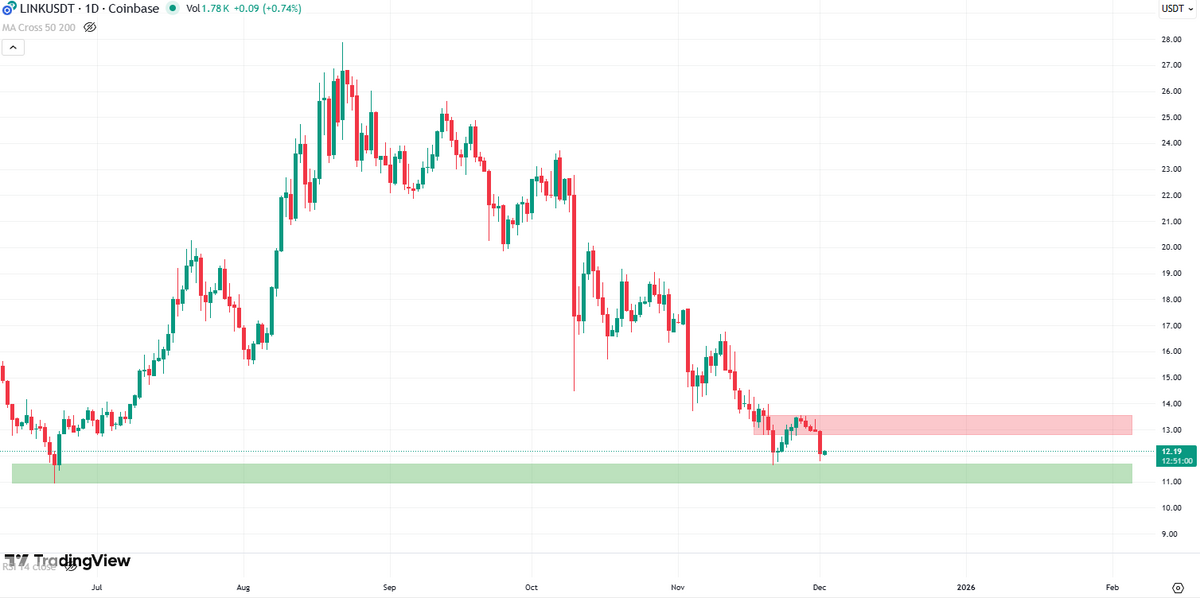
Chainlink ETF Set to Debut as LINK Slips Amid Market Weakness
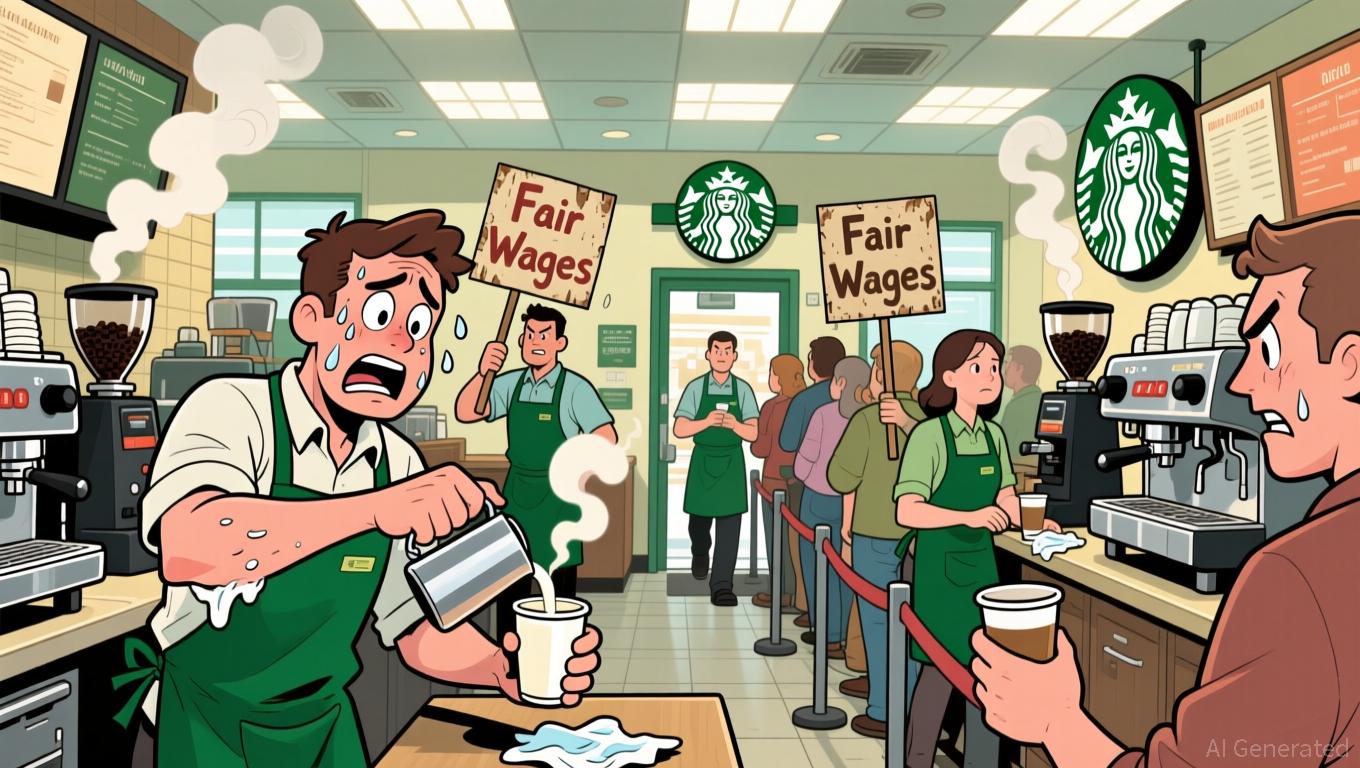
Striking baristas win $38.9 million in compensation, yet contract disputes continue
- Starbucks settles NYC Fair Workweek Law violations for $38.9M, including $35.5M restitution to 15,000+ workers. - Striking baristas demand collective bargaining amid ongoing labor disputes and unionization efforts at 550 stores. - Mayor-elect Mamdani and Sen. Sanders join protests, framing demands as moral issues against corporate resistance. - Settlement addresses 500,000 scheduling violations since 2021, with workers receiving $50/week compensation. - Starbucks defends labor law complexity but faces cr
Trending news
MoreCrypto prices
More





