Catfish effect? Are stablecoins really not the enemy of bank deposits?

Original Title: How Banks Learned To Stop Worrying And Love Stablecoins
Original Author: Christian Catalini, Forbes
Translation: Peggy, BlockBeats
Editor's Note: Whether stablecoins would disrupt the banking system has been one of the core debates in recent years. However, as data, research, and regulatory frameworks become clearer, the answer is becoming more rational: stablecoins have not triggered large-scale deposit outflows; instead, under the constraints of real-world "deposit stickiness," they have become a competitive force pushing banks to improve interest rates and efficiency.
This article re-examines stablecoins from the perspective of banks. They may not be a threat, but rather a catalyst forcing the financial system to renew itself.
The following is the original text:

In 1983, a dollar sign flashes on an IBM computer monitor.
Back in 2019, when we announced the launch of Libra, the reaction from the global financial system was, to put it mildly, intense. The almost existential fear was: if stablecoins could be used instantly by billions of people, would banks' control over deposits and payment systems be completely broken? If you could hold a "digital dollar" on your phone that could be transferred instantly, why would you keep your money in a zero-interest, fee-laden, and basically "shut down on weekends" checking account?
At the time, this was a perfectly reasonable question. For years, the mainstream narrative held that stablecoins were "taking away the banks' bread and butter." People worried that "deposit flight" was imminent.
Once consumers realized they could directly hold a digital cash backed by Treasury-grade assets, the foundation that provided the U.S. banking system with low-cost funding would quickly collapse.
But a recent rigorous research paper by Professor Will Cong of Cornell University shows that the industry may have panicked too soon. By examining real evidence rather than emotional judgments, Cong draws a counterintuitive conclusion: with proper regulation, stablecoins are not destroyers hollowing out bank deposits, but rather a complementary presence to the traditional banking system.
"Sticky Deposits" Theory
The traditional banking model is essentially a bet built on "friction."
Because checking accounts are the only true hub of interoperability for funds, almost any transfer of value between external services must go through the bank. The entire system is designed so that unless you use a checking account, operations become more cumbersome—the bank controls the only bridge connecting the "islands" of your financial life.
The reason consumers accept this "toll" is not because checking accounts are superior, but because of the power of the "bundling effect." You put your money in a checking account not because it's the best place for your funds, but because it's a central node: mortgages, credit cards, and direct payroll deposits all connect and coordinate here.
If the assertion that "banks are about to disappear" were true, we should have already seen a large flow of bank deposits into stablecoins. But that's not the case. As Cong points out, despite the explosive growth in stablecoin market cap, "existing empirical research has found almost no significant correlation between the emergence of stablecoins and the loss of bank deposits." The friction mechanism still works. So far, the spread of stablecoins has not caused substantial outflows from traditional bank deposits.
It turns out that warnings about "massive deposit flight" are more often panic-driven exaggerations by vested interests, ignoring the most basic economic "laws of physics" in the real world. Deposit stickiness is an extremely powerful force. For most users, the convenience value of "bundled services" is so high that it's not worth moving their life savings to a digital wallet just for a few extra basis points of yield.
Competition Is a Feature, Not a System Flaw
But real change is happening here. Stablecoins may not "kill banks," but they will almost certainly make banks uncomfortable and force them to improve. The Cornell study points out that even the mere existence of stablecoins imposes a disciplinary constraint, forcing banks to stop relying solely on user inertia and start offering higher deposit rates and more efficient, refined operations.
When banks truly face a credible alternative, the cost of complacency rises rapidly. They can no longer assume your funds are "locked in" by default, but must attract deposits at more competitive prices.
Within this framework, stablecoins do not "shrink the pie," but instead promote "more credit supply and broader financial intermediation, ultimately improving consumer welfare." As Professor Cong says: "Stablecoins are not meant to replace traditional intermediaries, but can serve as a complementary tool to expand the business boundaries banks are already good at."
It turns out that the "threat of exit" itself is a powerful driver for existing institutions to improve their services.
Regulatory "Unlocking"
Of course, regulators have every reason to worry about so-called "run risk"—that is, if market confidence falters, the reserve assets behind stablecoins could be forced into fire sales, triggering systemic crises.
But as the paper points out, this is not an unprecedented new risk, but a standard risk form long present in financial intermediation, essentially similar to the risks faced by other financial institutions. For liquidity management and operational risk, we already have a mature set of response frameworks. The real challenge is not to "invent new laws of physics," but to correctly apply existing financial engineering to a new technological form.
This is precisely where the GENIUS Act plays a key role. By explicitly requiring stablecoins to be fully backed by cash, short-term U.S. Treasuries, or insured deposits, the act sets hard requirements for safety at the institutional level. As the paper notes, these regulatory guardrails "appear to cover the core vulnerabilities identified in academic research, including run risk and liquidity risk."
This legislation sets a minimum statutory standard for the industry—full reserves and enforceable redemption rights—but leaves the specific operational details to be implemented by banking regulators. Next, the Federal Reserve and the Office of the Comptroller of the Currency (OCC) will be responsible for turning these principles into enforceable regulatory rules, ensuring that stablecoin issuers fully account for operational risk, the possibility of custodial failure, and the unique complexities of large-scale reserve management and blockchain system integration.
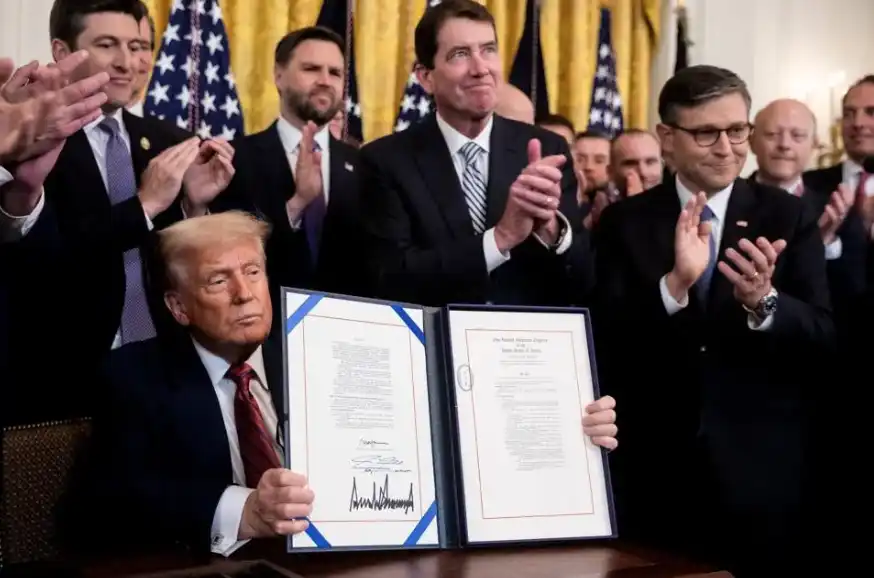
On Friday, July 18, 2025, U.S. President Donald Trump displays the just-signed GENIUS Act at a signing ceremony in the East Room of the White House in Washington, D.C.
Efficiency Dividend
Once we move beyond the defensive mindset of "deposit diversion," the real upside becomes apparent: the "underlying pipes" of the financial system itself are overdue for reconstruction.
The true value of tokenization is not just 24/7 availability, but "atomic settlement"—instant cross-border value transfer without counterparty risk, a problem the current financial system has long been unable to solve.
Today's cross-border payment systems are costly and slow, with funds often taking days to settle as they pass through multiple intermediaries. Stablecoins compress this process into a single, on-chain, final and irreversible transaction.
This has profound implications for global cash management: funds no longer need to be "stuck in transit" for days, but can be allocated instantly across borders, releasing liquidity long trapped by the correspondent banking system. In domestic markets, the same efficiency gains mean lower costs and faster merchant payment methods. For the banking industry, this is a rare opportunity to update the traditional clearing infrastructure long held together by duct tape and COBOL.
The Upgrade of the Dollar
Ultimately, the U.S. faces a binary choice: either lead the development of this technology, or watch the future of finance take shape in offshore jurisdictions. The dollar remains the world's most popular financial product, but the "rails" supporting its operation are clearly outdated.
The GENIUS Act provides a truly competitive institutional framework. It "localizes" this sector: by bringing stablecoins within the regulatory perimeter, the U.S. turns the uncertainties of the shadow banking system into a transparent, robust "global dollar upgrade plan," transforming an offshore novelty into a core component of domestic financial infrastructure.
Banks should no longer be entangled in competition itself, but should start thinking about how to turn this technology into their own advantage. Just as the music industry was forced to move from the CD era to the streaming era—initially resistant, but ultimately discovering a gold mine—banks are resisting a transformation that will ultimately save them. When they realize they can charge for "speed" instead of profiting from "delay," they will truly learn to embrace this change.

A New York University student downloads music files from the Napster website in New York. On September 8, 2003, the Recording Industry Association of America (RIAA) filed lawsuits against 261 file sharers who downloaded music files over the Internet; in addition, the RIAA issued more than 1,500 subpoenas to Internet service providers.
Disclaimer: The content of this article solely reflects the author's opinion and does not represent the platform in any capacity. This article is not intended to serve as a reference for making investment decisions.
You may also like
Ripple CEO Declares ‘Nobody Can Manipulate XRP Prices’ amid December Volatility. Here’s Why.
Expert to XRP Holders: This Will Be One of the Biggest Fakeouts in History If This Happens
BTC price outlook: short-term bounce inside a larger downtrend
Best Solana Wallets as Visa Chooses Solana and USDC for US Bank Settlements