Glassnode: Bitcoin Weakly Fluctuates, Is Major Volatility Coming?

If signs of seller exhaustion begin to appear, a short-term move towards $95,000 and the short-term holder cost basis is still possible.
Original Title: Anchored, But Under Strain
Original Authors: Chris Beamish, CryptoVizArt, Antoine Colpaert, Glassnode
Original Translation: AididiaoJP, Foresight News
Bitcoin remains trapped in a fragile range, with unrealized losses increasing, long-term holders selling, and demand remaining weak. ETF and liquidity remain sluggish, the futures market is weak, and options traders are pricing in short-term volatility. The market is currently stable, but confidence is still lacking.
Summary
Bitcoin remains in a structurally fragile range, under pressure from increasing unrealized losses, high realized losses, and significant profit-taking by long-term holders. Nevertheless, demand is anchoring the price above the true market mean.
The market has failed to reclaim key thresholds, particularly the short-term holder cost basis, reflecting ongoing selling pressure from recent high buyers and seasoned holders. If signs of seller exhaustion appear, a retest of these levels in the short term is possible.
Off-chain indicators remain weak. ETF flows are negative, spot liquidity is thin, and futures open interest shows a lack of speculative confidence, making prices more sensitive to macro catalysts.
The options market shows defensive positioning, with traders buying short-term implied volatility (IV) and continuing to show demand for downside protection. The volatility surface signals caution in the short term, but sentiment is more balanced for longer maturities.
With the FOMC meeting as the last major catalyst of the year, implied volatility is expected to gradually decay in late December. The market's direction depends on whether liquidity improves and sellers step back, or if the current time-driven bearish pressure persists.
On-chain Insights
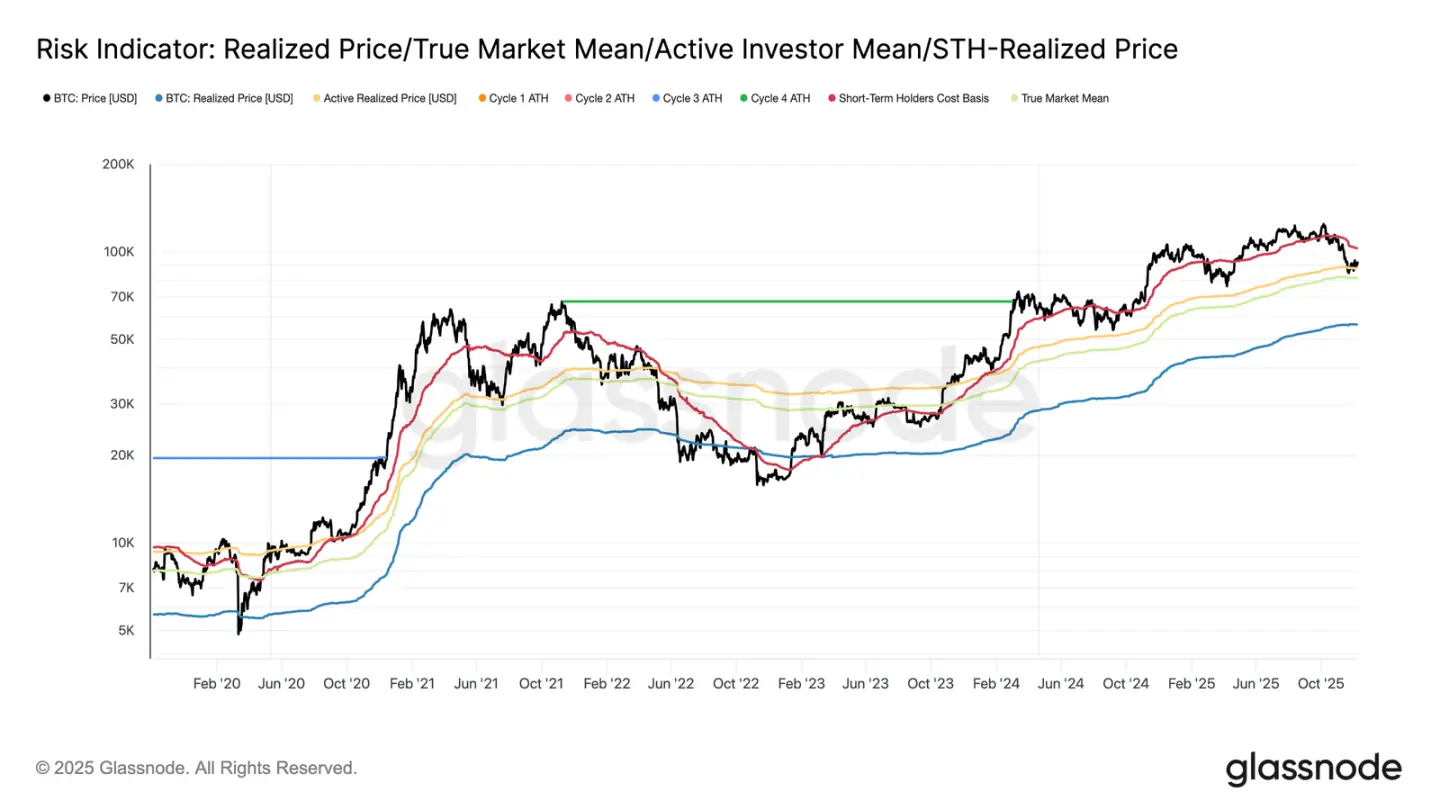
As Bitcoin entered this week, it remained constrained within a structurally fragile range, with the upper boundary at the short-term holder cost basis ($102,700), and the lower boundary at the true market mean ($81,300). Last week, we highlighted weakening on-chain conditions, thin demand, and a cautious derivatives landscape, all echoing the market structure of early 2022.
Although the price is barely holding above the true market mean, unrealized losses continue to expand, realized losses are rising, and long-term investor spending remains elevated. The key upper limit to reclaim is the 0.75 cost basis quantile ($95,000), followed by the short-term holder cost basis. Until then, barring a new macro shock, the true market mean remains the most likely bottom formation area.
Time Works Against the Bulls
The market remains in a mild bearish phase, reflecting the tension between moderate capital inflows and persistent selling pressure from high-level buyers. As the market drifts within a weak but bounded range, time becomes a negative force, making it harder for investors to endure unrealized losses and increasing the likelihood of realized losses.
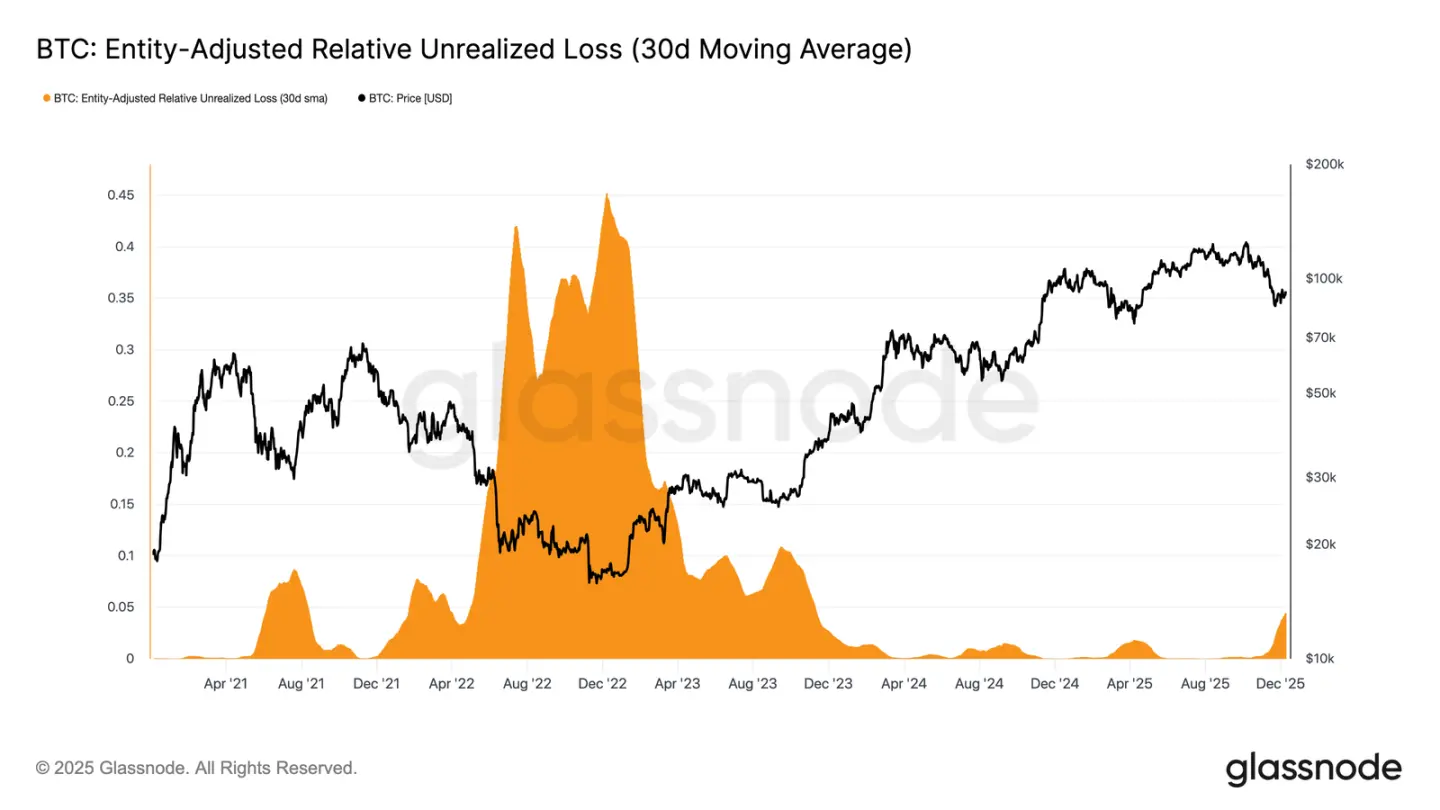
Relative unrealized losses (30-day simple moving average) have climbed to 4.4%, after staying below 2% for nearly two years, marking a shift from a frenzy phase to one of heightened stress and uncertainty. This indecision currently defines the price range, and resolving it will require a new wave of liquidity and demand to rebuild confidence.
Losses Increase
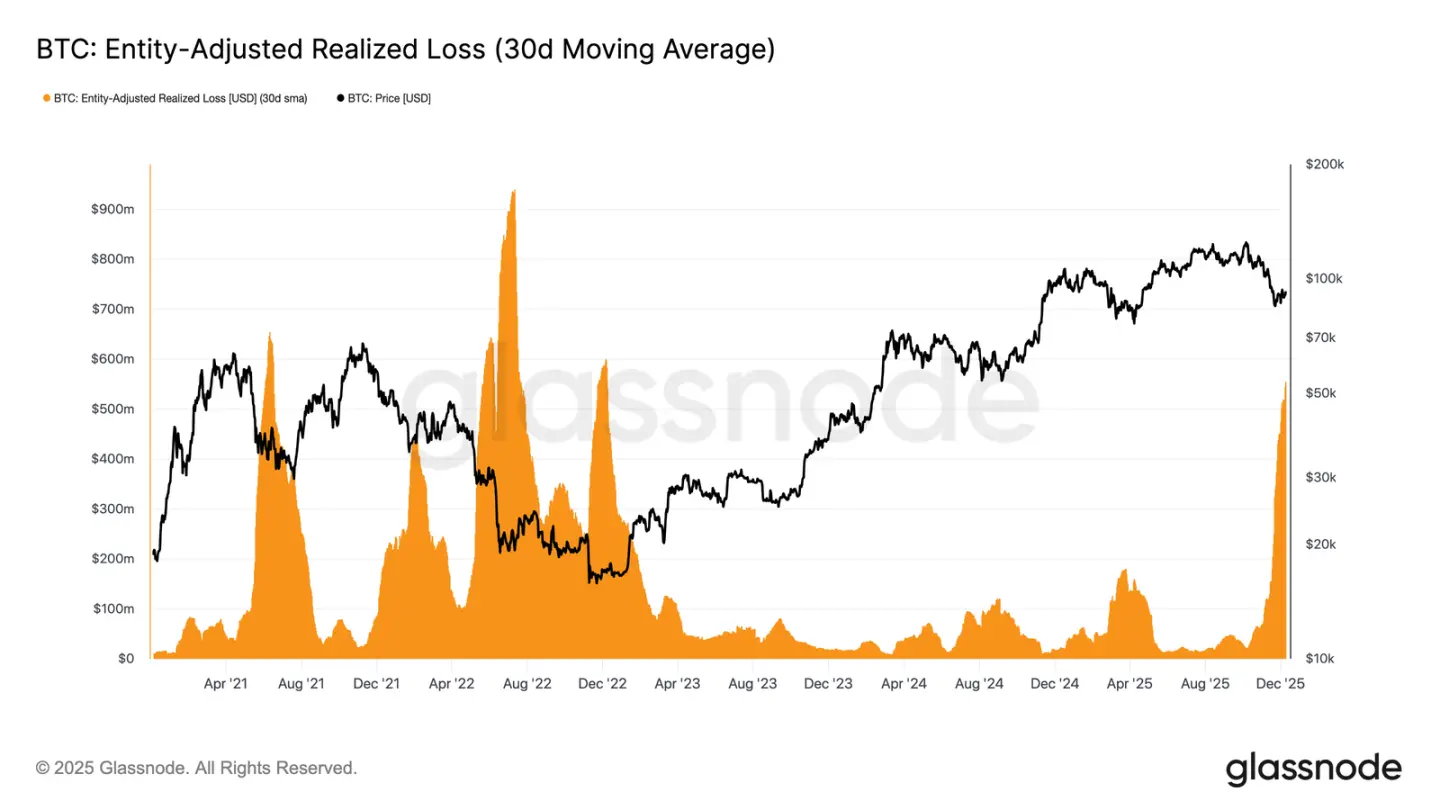
This time-driven pressure is even more evident in spending behavior. Although Bitcoin rebounded from its November 22 low to about $92,700, the 30-day simple moving average of entity-adjusted realized losses has continued to climb, reaching $555 million per day, the highest level since the FTX collapse.
Such high realized losses during a moderate price recovery reflect growing frustration among high-level buyers, who choose to capitulate during market strength rather than hold through the rebound.
Obstructing a Reversal
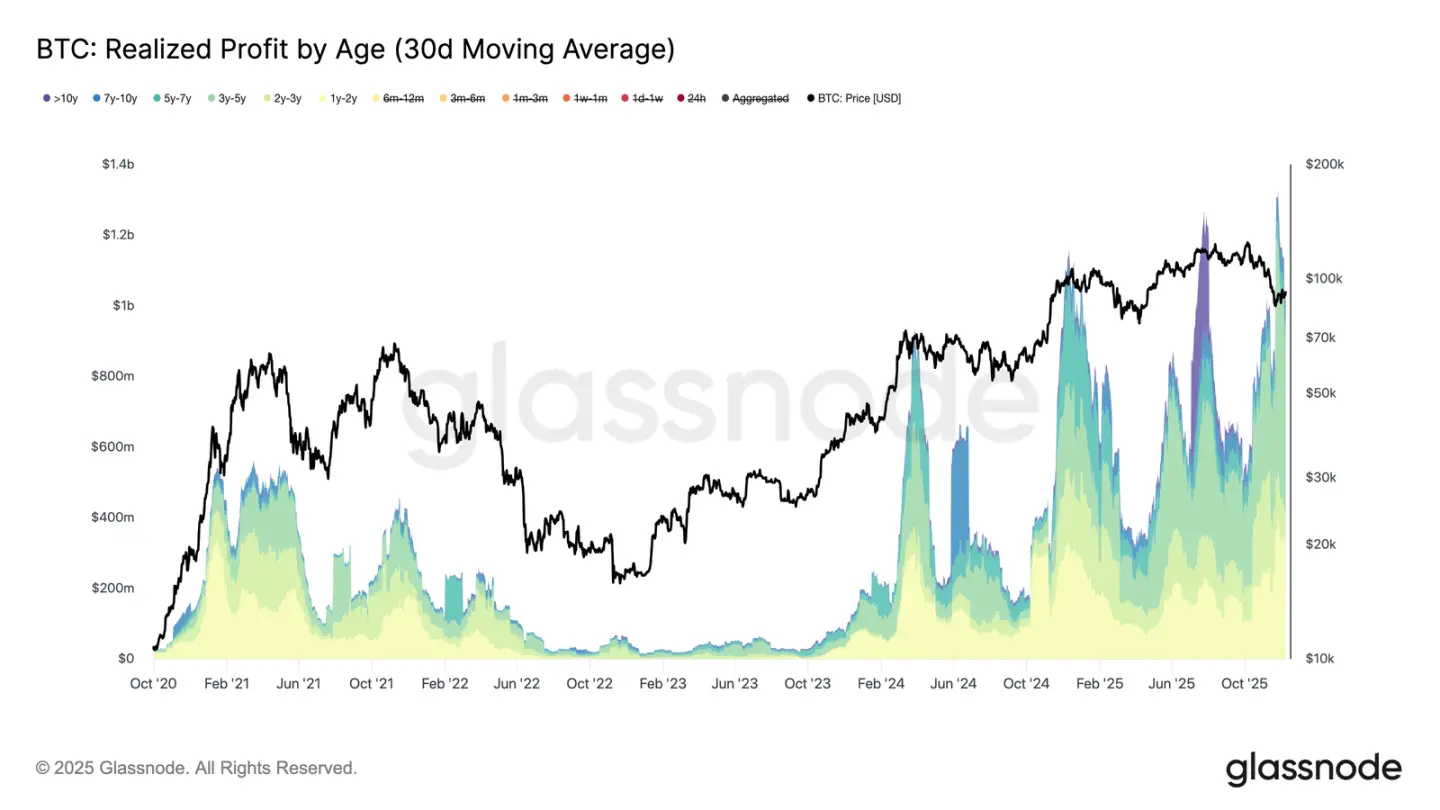
Rising realized losses further drag on the recovery, especially when they coincide with a surge in realized profits by seasoned investors. In the recent rebound, realized profits for holders of over one year (30-day simple moving average) exceeded $1 billion per day, peaking at a new all-time high above $1.3 billion. The combination of capitulation by high-level buyers and massive profit-taking by long-term holders explains why the market is still struggling to reclaim the short-term holder cost basis.
However, despite such massive selling pressure, the price has stabilized and even slightly rebounded above the true market mean, indicating that persistent and patient demand is absorbing the sell-off. In the short term, if sellers begin to show signs of exhaustion, this underlying buying pressure could drive a retest of the 0.75 quantile (around $95,000) and even the short-term holder cost basis.
Off-chain Insights
ETF Dilemma
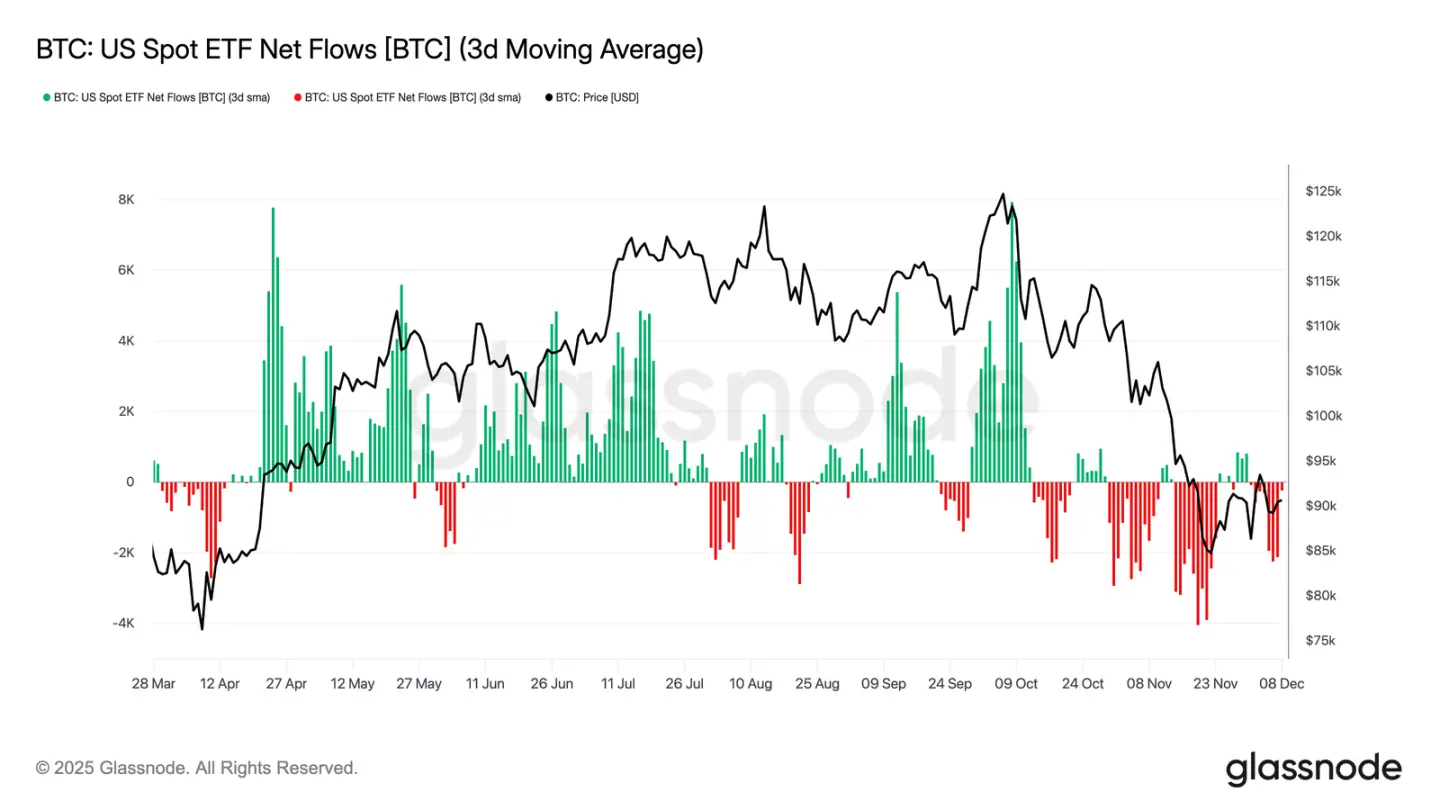
Turning to the spot market, US Bitcoin ETFs have had another quiet week, with the three-day average net inflow remaining negative. This continues the cooling trend that began in late November, marking a clear departure from the strong inflow mechanism that supported price increases earlier this year. Redemptions by several major issuers remain steady, highlighting a more risk-averse stance among institutional allocators amid a broader unstable market environment.
As a result, the demand buffer in the spot market has thinned, reducing immediate buy-side support and making prices more susceptible to macro catalysts and volatility shocks.
Liquidity Remains Sluggish
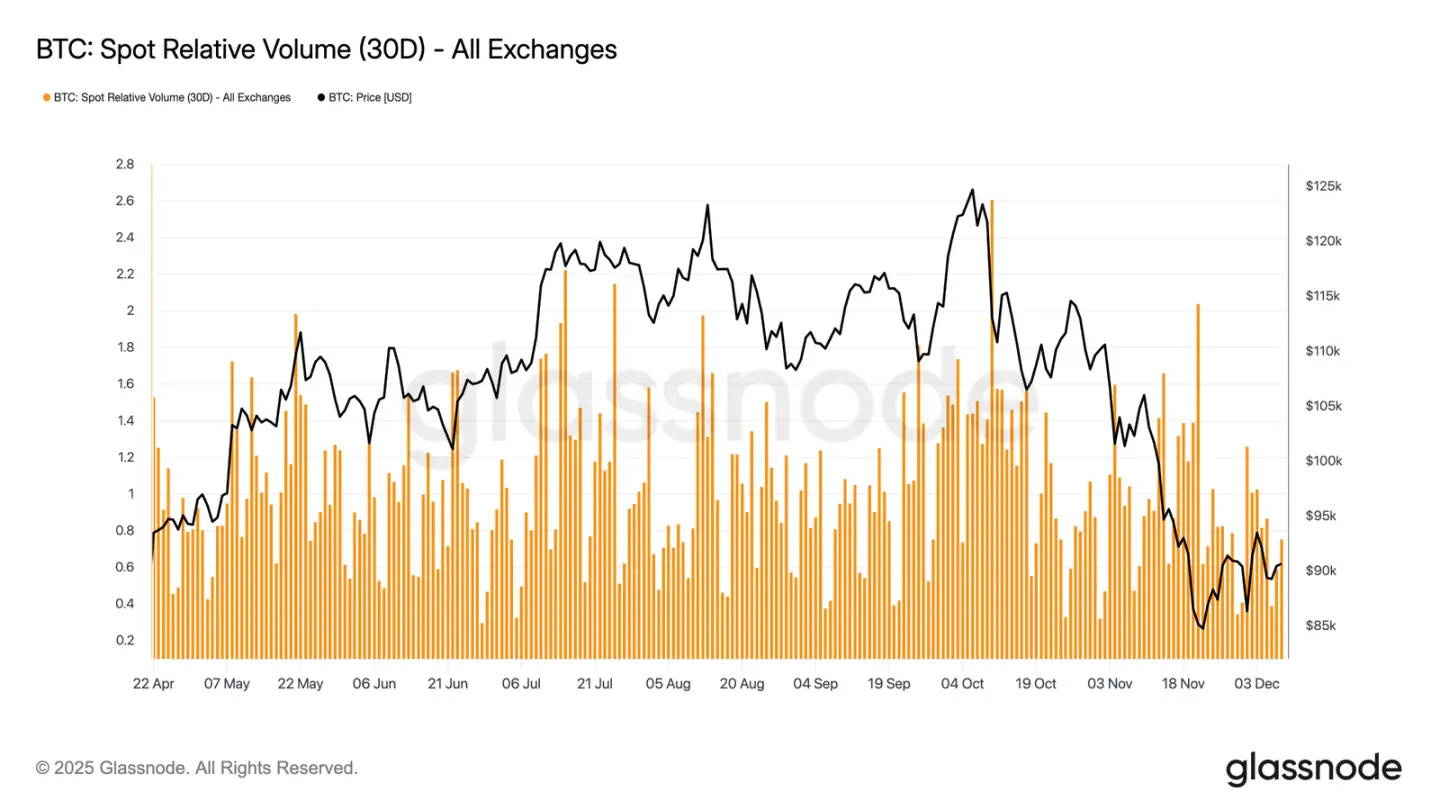
In parallel with weak ETF flows, Bitcoin's spot relative trading volume continues to hover near the lower end of its 30-day range. Trading activity has continued to weaken from November to December, reflecting falling prices and declining market participation. The contraction in volume reflects a more defensive overall market positioning, with less liquidity-driven capital flow available to absorb volatility or sustain directional moves.
As the spot market quiets, attention now turns to the upcoming FOMC meeting, which, depending on its policy tone, could serve as a catalyst to reactivate market participation.
Futures Market Sluggish
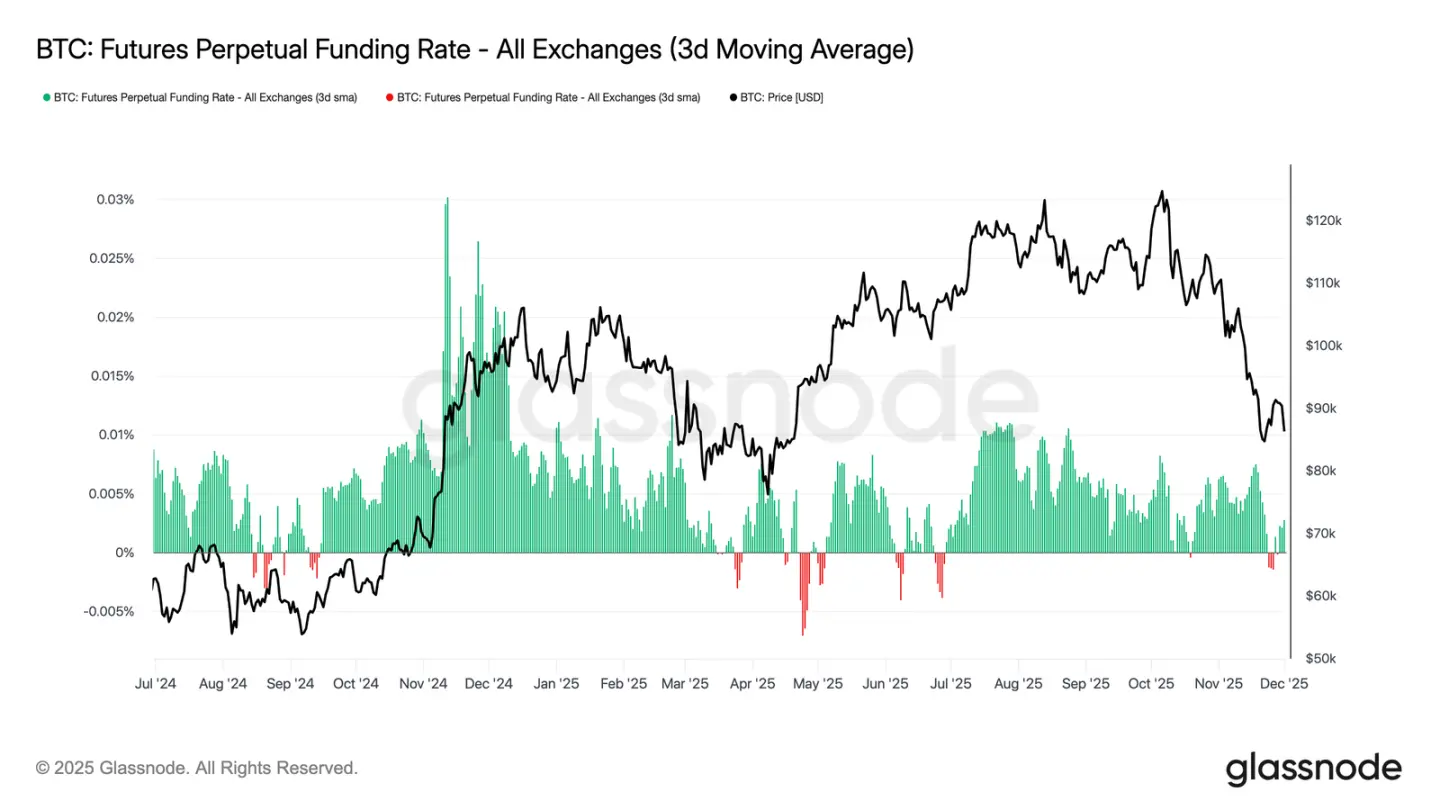
Continuing the theme of low market participation, the futures market also shows limited interest in leverage, with open interest failing to meaningfully rebuild and funding rates remaining near neutral. These dynamics highlight a derivatives environment defined by caution rather than confidence.
In the perpetual contracts market, funding rates hovered near zero to slightly negative this week, underscoring the continued withdrawal of speculative long positions. Traders are maintaining a balanced or defensive stance, applying little directional pressure through leverage.
With derivatives activity subdued, price discovery is more influenced by spot capital flows and macro catalysts rather than speculative expansion.
Short-term Implied Volatility Surges
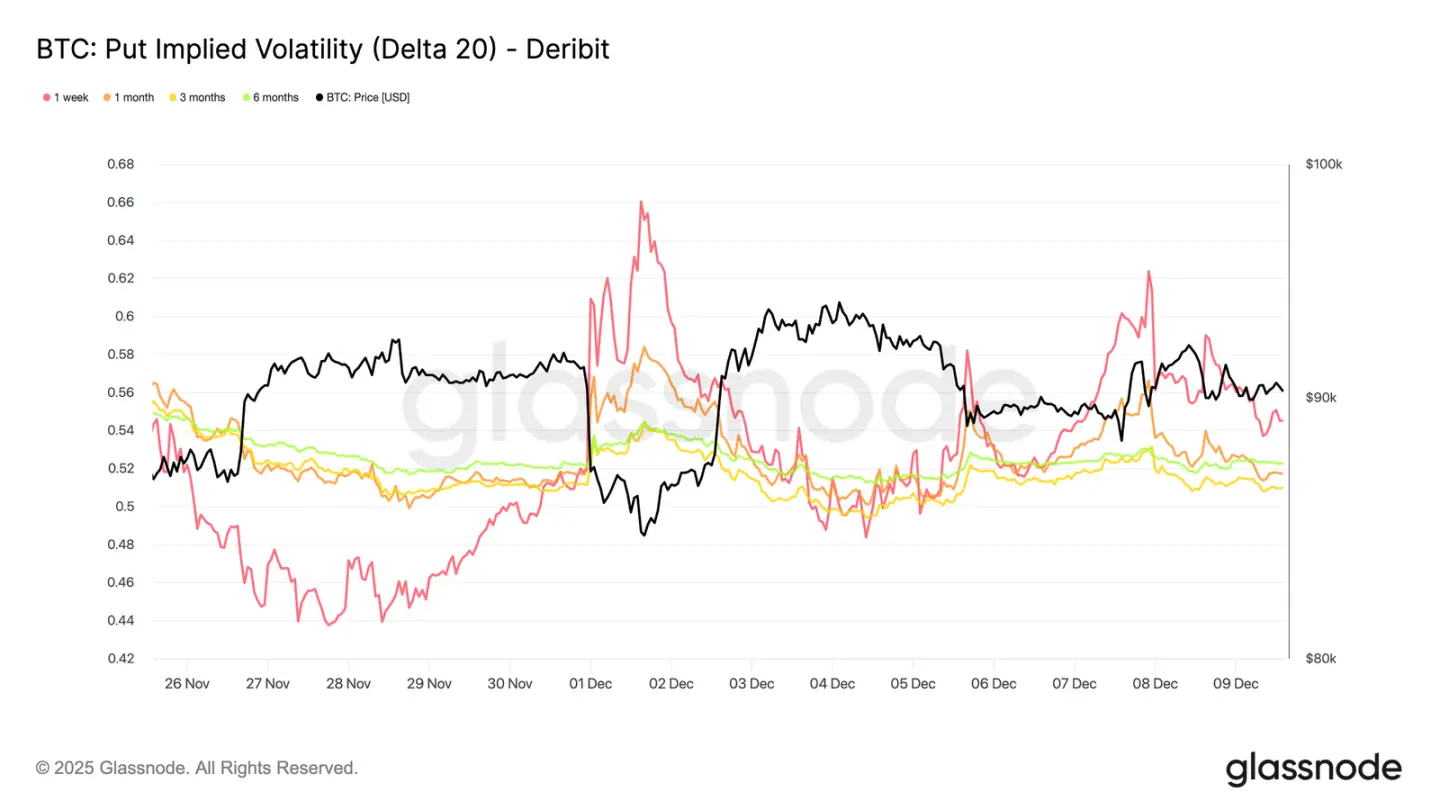
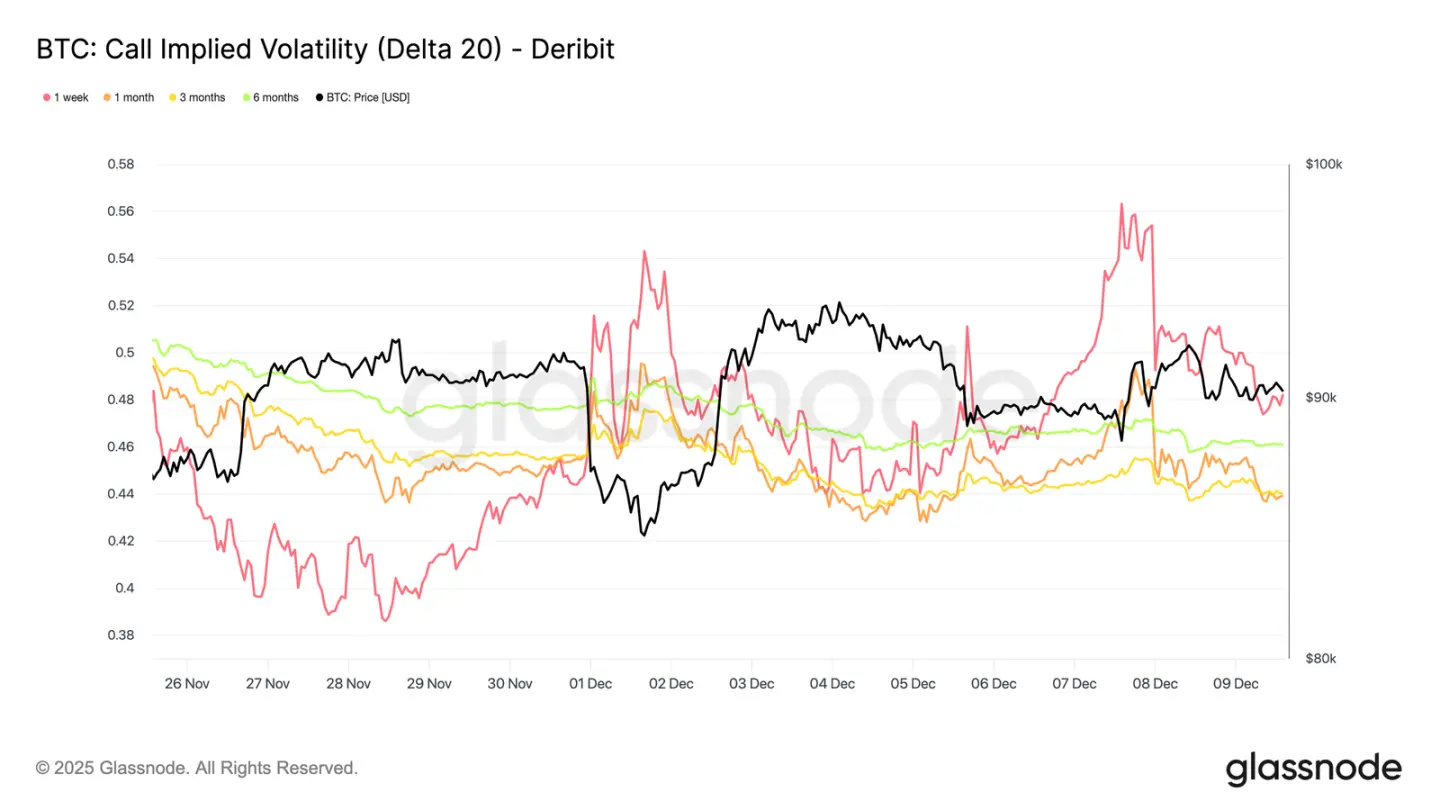
Turning to the options market, Bitcoin's muted spot activity stands in sharp contrast to a sudden surge in short-term implied volatility, as traders position for larger price moves. Interpolated implied volatility (estimated by fixed Delta values rather than listed strike prices) reveals the risk pricing structure across different maturities more clearly.
For 20-Delta call options, one-week IV rose by about 10 volatility points from last week, while longer maturities remained relatively stable. The same pattern appeared for 20-Delta put options, with short-term downside IV rising and longer maturities staying calm.
Overall, traders are accumulating volatility where they expect stress to emerge, preferring to hold convexity rather than sell ahead of the December 10 FOMC meeting.
Downside Demand Returns
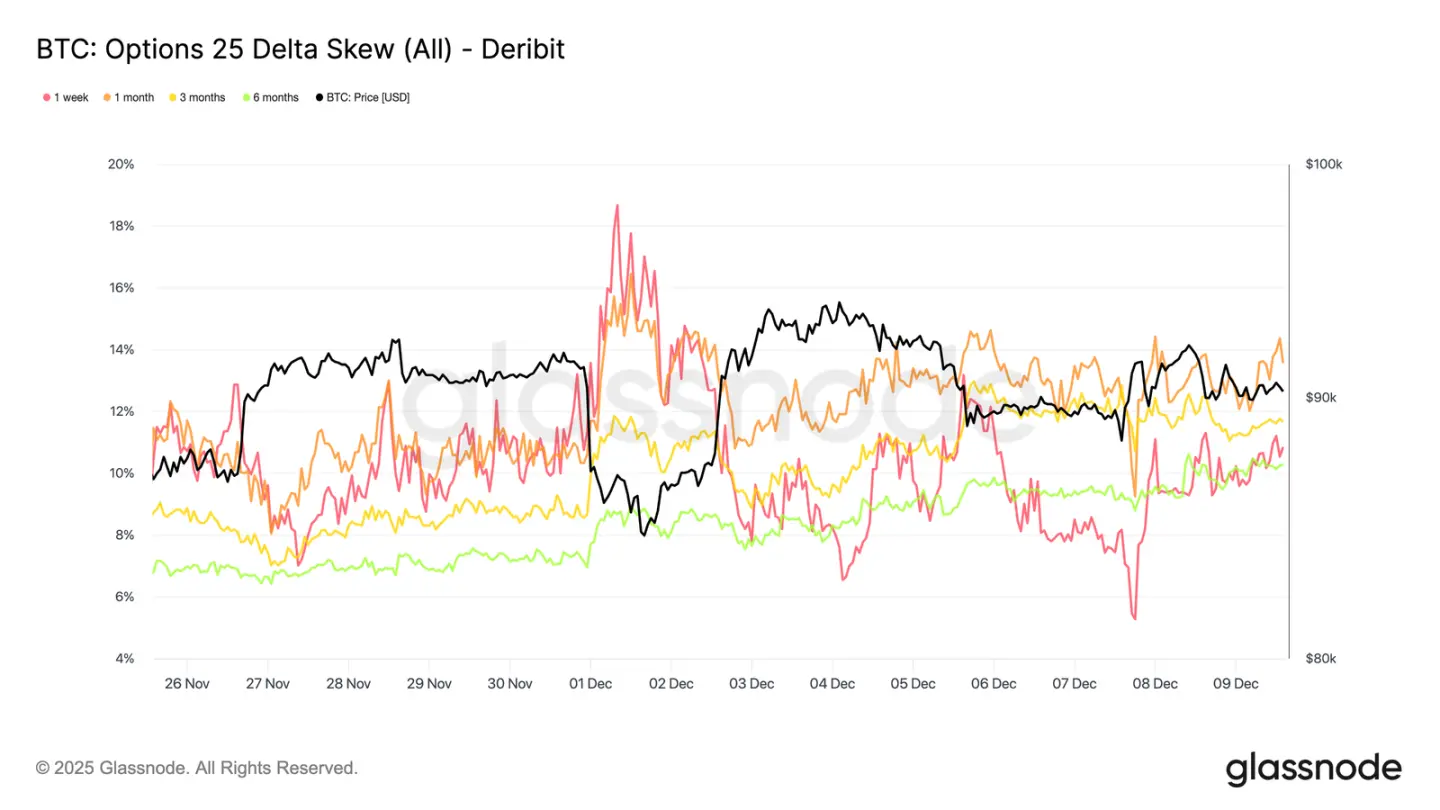
Accompanying the rise in short-term volatility, downside protection has once again gained a premium. The 25-delta skew, which measures the relative cost of puts versus calls at the same Delta, has climbed to about 11% for the one-week maturity, indicating a clear increase in demand for short-term downside insurance ahead of the FOMC meeting.
Skew remains tightly clustered across maturities, ranging from 10.3% to 13.6%. This compression indicates a preference for put protection across the entire curve, reflecting a consistent risk-averse tendency rather than isolated short-term stress.
Volatility Accumulation
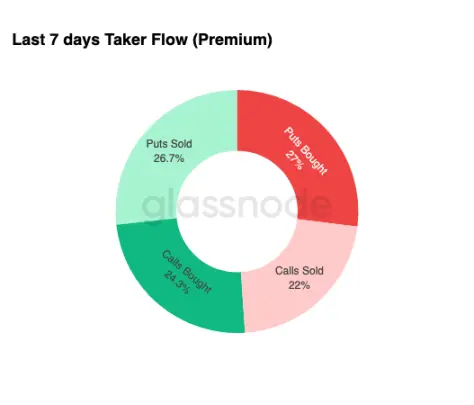
Summarizing the options market conditions, weekly flow data reinforces a clear pattern: traders are buying volatility, not selling it. Purchased option premiums dominate total notional flows, with puts slightly ahead. This does not reflect a directional bias, but rather a state of volatility accumulation. When traders buy both ends of the options spectrum, it signals hedging and a search for convexity, rather than sentiment-driven speculation.
Combined with rising implied volatility and a downside-leaning skew, the flow situation indicates that market participants are preparing for volatility events, with a downside bias.
After the FOMC
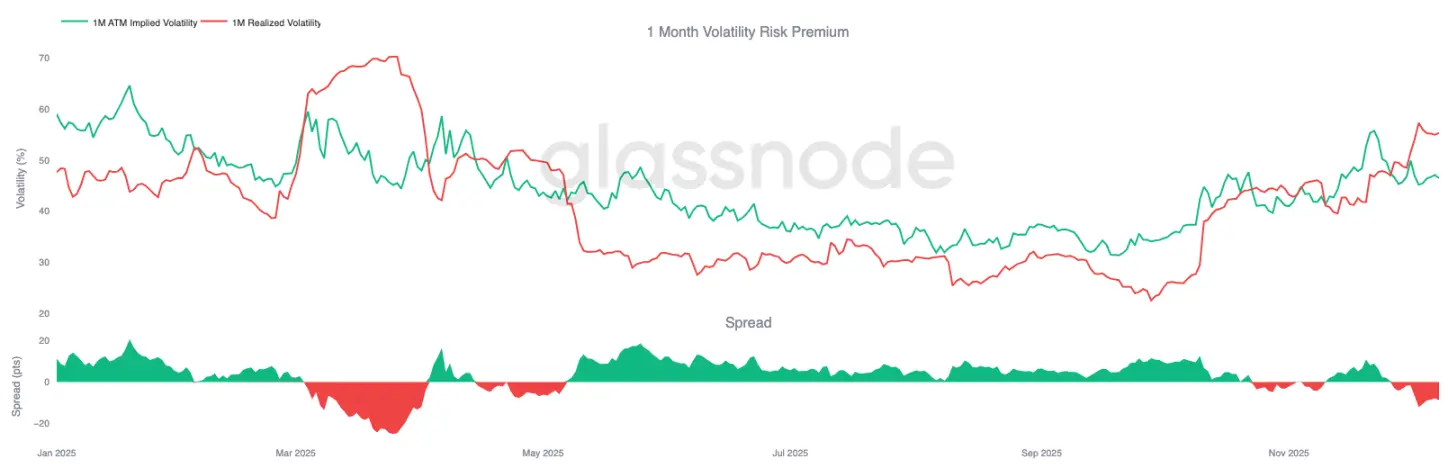
Looking ahead, implied volatility has already begun to ease, and historically, once the last major macro event of the year passes, IV tends to compress further. With the December 10 FOMC meeting as the last meaningful catalyst, the market is preparing to transition to a low-liquidity, mean-reverting environment.
After the announcement, sellers typically re-enter, accelerating IV decay before year-end. Unless there is a hawkish surprise or a significant shift in guidance, the path of least resistance points to lower implied volatility and a flatter volatility surface, continuing into late December.
Conclusion
Bitcoin continues to trade in a structurally fragile environment, with rising unrealized losses, high realized losses, and significant profit-taking by long-term holders collectively anchoring price action. Despite ongoing selling pressure, demand remains resilient enough to keep prices above the true market mean, indicating that patient buyers are still absorbing the sell-off. If signs of seller exhaustion begin to appear, a short-term move toward $95,000 and the short-term holder cost basis remains possible.
Off-chain conditions echo this cautious tone. ETF flows remain negative, spot liquidity is sluggish, and the futures market lacks speculative participation. The options market reinforces the defensive stance, with traders accumulating volatility, buying short-term downside protection, and positioning for near-term volatility events ahead of the FOMC meeting.
Overall, the market structure suggests a weak but stable range, supported by patient demand but constrained by ongoing selling pressure. The short-term path depends on whether liquidity improves and sellers step back, while the long-term outlook hinges on whether the market can reclaim key cost basis thresholds and break out of this time-driven, psychologically stressful phase.
Disclaimer: The content of this article solely reflects the author's opinion and does not represent the platform in any capacity. This article is not intended to serve as a reference for making investment decisions.
You may also like
Terra Luna Classic Shakes the Crypto Market with Surprising Developments
In Brief LUNC experienced a significant price decline following Do Kwon's sentencing. The court cited over $40 billion losses as a reason for Do Kwon's penalty. Analysts suggest short-term pressure on LUNC may persist, despite long-term community support.

NYDIG: Tokenized Assets Offer Modest Crypto Gains as Growth Depends on Access and Regulation
Cardano Investors Split As Market Fatigue Sets In