The Rise of Trust Wallet Token (TWT): An Analysis Following Exchange Integration
- TWT's 2025 surge stems from strategic innovations, institutional adoption, and deflationary tokenomics. - Expanded utility via FlexGas, prediction markets, and RWA integrations boosts demand while burning 10%+ supply. - Institutional confidence grows through Ondo Finance partnership and Binance co-founder CZ's endorsement, driving 50% price jump. - Analysts project $5.13 by 2025 and $15 by 2030 if RWA and cross-chain adoption continue accelerating.
Trust Wallet Token (TWT): 2025 Growth Analysis
In 2025, Trust Wallet Token (TWT) has witnessed significant growth, propelled by innovative product launches, increased institutional involvement, and a deflationary supply structure. This overview examines how recent exchange listings and expanded token utility have influenced TWT’s market performance, offering a perspective on its future price trends and long-term outlook.
Scarcity and Expanding Use Cases: The Evolving Value of TWT
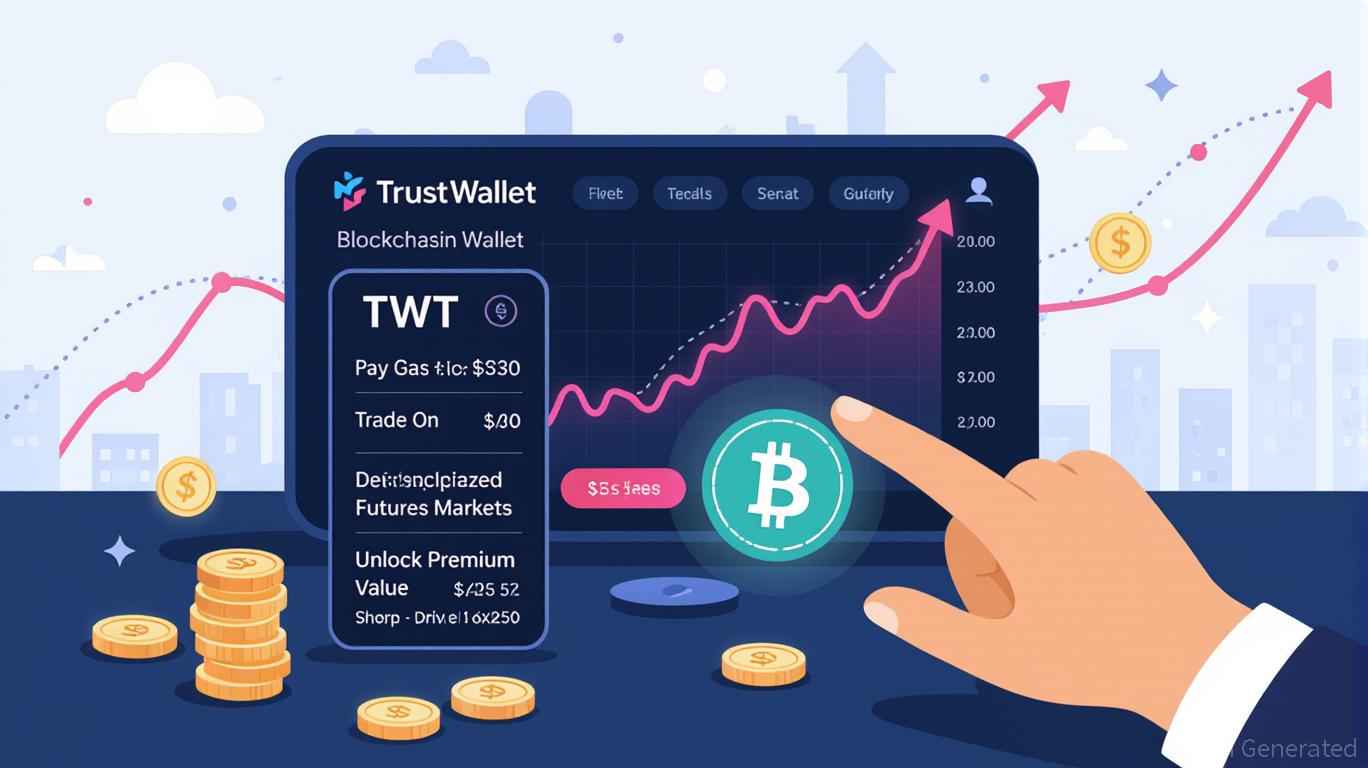
TWT has transformed from a simple governance token into a versatile asset with practical applications, aligning with modern blockchain valuation frameworks. Trust Wallet has introduced features such as perpetual futures with up to 100X leverage, prediction markets, and gas-free transaction solutions (FlexGas), all of which have broadened the token’s utility and increased demand throughout the ecosystem.
FlexGas, for example, enables users to cover transaction fees on both BNB Chain and Ethereum using TWT, USDT, or USDC. This mechanism reduces the circulating supply of TWT, thereby increasing its scarcity. Regular token burns further decrease the available supply—by late 2025, over 10% of TWT’s circulating tokens have been destroyed, a factor often linked to price growth in utility tokens.
Holders of TWT also enjoy benefits such as 10% discounts on gas fees, enhanced staking rewards, and exclusive airdrops. These incentives encourage active participation and create a positive feedback loop that supports the token’s value.
Institutional Adoption and Shifting Market Sentiment
The market’s focus has shifted from retail speculation to institutional investment, a trend accelerated by TWT’s integration with real-world assets. Trust Wallet’s collaboration with Ondo Finance to tokenize U.S. Treasury bonds has attracted institutional players looking for stable, blockchain-based alternatives to traditional investments. This partnership has broadened TWT’s user base, with on-chain metrics revealing a 40% rise in staking and a decrease in token turnover, indicating stronger long-term commitment from holders.
Institutional confidence in TWT was further reinforced when Binance co-founder Changpeng Zhao publicly endorsed the token, resulting in a 50% price surge. Such endorsements have strengthened TWT’s reputation as a potential hedge against fiat currency inflation, especially as it becomes a core component of Trust Premium—a loyalty program that offers gas fee reductions and exclusive features to its members.
Cross-Chain Integration and Future Prospects
TWT’s compatibility with multiple blockchains and its integration into DeFi protocols position it to benefit from the expanding adoption of decentralized finance. The token is expected to serve as collateral on various DeFi platforms (with specific partners yet to be announced) and is already used in Trust Pay and Trust Card, enabling fee-free peer-to-peer transfers and merchant payments. These developments highlight TWT’s potential to connect traditional finance with the Web3 ecosystem.
Market analysts forecast that TWT could reach $5.13 by the end of 2025 and potentially $15 by 2030, provided that integration with real-world assets and cross-chain adoption continue to progress. These projections are consistent with historical trends, where utility tokens featuring deflationary mechanisms and expanding use cases tend to outperform during bullish market cycles.
Summary
The impressive rise of Trust Wallet Token is the result of expanding utility, growing institutional interest, and a carefully managed deflationary model. As TWT evolves from a governance-focused token to a multi-functional asset, its valuation increasingly resembles that of leading blockchain projects. Investors should keep an eye on upcoming DeFi integrations and the expansion of Trust Premium, both of which could further strengthen TWT’s standing in the cryptocurrency landscape.
Disclaimer: The content of this article solely reflects the author's opinion and does not represent the platform in any capacity. This article is not intended to serve as a reference for making investment decisions.
You may also like
Navigating the Emergence of Decentralized Finance (DeFi): A Tactical Handbook for Investors in 2026
- Aster DEX dominates 19.3% of perpetual DEX market by Q3 2025 with hybrid AMM-CEX model reducing slippage by 40% and $27.7B daily volume. - Platform bridges TradFi/DeFi through Binance/APX partnerships, aligning with MiCAR/CLARITY Act while securing $50B in Layer-2 assets via ZKP-powered Aster Chain. - ASTER token surged 1,650% post-TGE with $80M burns and 80% margin trading driving 30% price jumps, while 2026 roadmap targets RWA integration and institutional onboarding. - Projected 72.8% CAGR in RWA mark
Investment Prospects in STEM Learning and Workforce-Ready Talent Streams: Linking with Astar 2.0
- Global STEM education demand surges as AI, blockchain, and biotech reshape industries, creating workforce skill gaps. - Astar 2.0's DeFi innovations (ZK Rollups, interoperability) indirectly support STEM through blockchain infrastructure and cross-chain collaboration. - U.S. and Singapore prioritize tech-integrated workforce strategies, aligning with Astar 2.0's potential to bridge DeFi and STEM education via scalable tools. - Investors can leverage Astar 2.0's $1.399B TVL and hybrid AMM-CEX model to fun

The ZK Transformation: Evaluating How Zero-Knowledge Technology Influences the Future Development of Blockchain
- ZK-rollups scale blockchain networks by bundling transactions, achieving 43,000 TPS and 30% lower gas fees, attracting institutions like Goldman Sachs and JPMorgan . - ZK technology resolves privacy-scalability paradox by enabling verifiable transactions without data exposure, adopted by EU regulators and enterprises like Nike and Sony . - Challenges persist: ZK-SNARKs require heavy computation, trusted setup risks exist, and privacy conflicts with AML regulations in some jurisdictions. - $725M+ VC inves

The Influence of Vitalik Buterin's Support for ZKsync on the Advancement of Scalable Blockchain Technologies: Evaluating the Prospects for Long-Term Investment in Pr
- Vitalik Buterin's 2025 endorsement of ZKsync accelerated its rise as a scalable Ethereum Layer-2 solution with 30,000 TPS and $3.3B TVL. - ZKsync's EVM compatibility and institutional partnerships contrast with StarkNet's quantum-resistant STARK proofs and Aztec's privacy-first architecture. - Analysts project ZK token prices at $0.40–$0.60 by 2025, while StarkNet faces adoption barriers and Aztec navigates regulatory challenges in privacy-focused DeFi. - The $7.59B ZKP market (2033 forecast) hinges on b