
[English Long Tweet] Building the AI Sovereign Stack: How to Ensure Verifiability of AI Agents in the Off-chain World

Chainfeeds Guide:
Once AI Agents migrate off-chain to obtain the necessary computing power and data, they will inevitably have to rely on servers, API keys, and model weights controlled by a particular entity. Thus, the question becomes: how can we extend sovereignty to AI Agents that need to operate in complex off-chain environments?
Source:
Author:
nader dabit
Opinion:
nader dabit: In the new generation of on-chain Agent systems, identity and reputation have become indispensable infrastructure. Standards represented by ERC-8004 provide publicly queryable on-chain identity registries for agents, enabling different entities to discover each other across organizations and platforms, and to accumulate verifiable reputation through cryptographically authorized feedback systems. The results of agents’ work no longer have to rely solely on centralized platform endorsements, but can be independently proven through plug-and-play verification systems—for example, re-execution verification based on staking protection, zkML proof mechanisms, or hardware proofs from Trusted Execution Environments (TEE). These capabilities allow agents to expand from low-risk tasks (such as ordering takeout) to high-risk decisions (such as financial trading or medical diagnosis) without the need to establish trust relationships in advance. Virtuals’ ACP further combines ERC-6551 identities with a complete business coordination framework, providing structured processes for agent collaboration, negotiation, and payment. At the same time, SDKs like Agent0 and Chaos Chain enable developers to build multi-chain autonomous agents with identity, reputation, and verification capabilities without needing deep understanding of underlying cryptography. In order for agents to truly achieve autonomous transactions and self-governed operations, the foundational layers of payment and computation are being restructured. Protocols like x402 and AP2 offer frictionless on-chain micropayments and payment vouchers, allowing agents to interact at high frequency and extremely low cost; infrastructures like AltLayer and Faremeter make x402 integration chain-agnostic and seamless; streaming payment protocols such as Superfluid allow agents to realize real-time value transfer without manual transaction handling. On the computation layer, Trusted Execution Environments (TEE) such as EigenCompute, Oasis, and Phala provide cryptographic-level execution guarantees: even underlying operators cannot interfere with their code and memory. Enclave key management in TEE enables agents’ cryptographic identities to remain consistent during restarts, upgrades, and even migrations, ensuring their sovereignty does not depend on any single infrastructure. All configuration changes and deployments of agents can be recorded on-chain, auditable and traceable, ensuring their operational logic is governed by smart contracts rather than server administrators. Meanwhile, zkVMs such as Brevis, RiscZero, and Succinct provide zero-knowledge computation proofs, enabling agents to prove to third parties that their computation processes are genuine and correct without revealing privacy or proprietary logic, thus providing a trust foundation for high-risk scenarios. As AI capabilities become a core component of agents, verifiability and sovereignty become key requirements. EigenAI provides deterministic inference: the same input will always produce the same output, and the model execution process is verifiable, preventing infrastructure tampering and supporting independent recomputation. zkML solutions such as EZKL, Ritual, and Zama supplement AI inference with zero-knowledge proof capabilities, allowing agents to prove their decisions are correct without exposing models, data, or internal states. At the storage and “memory” layer, Arweave, Filecoin, Irys, DataHaven, and IPFS provide tamper-proof decentralized storage, with every decision, transaction, and interaction of the agent recorded as permanent, auditable history, forming its long-term reputation assets. Account abstraction and smart accounts (such as Privy, Dynamic, Magic, ZeroDev, Safe, Biconomy, etc.) provide agents with fine-grained permission control, allowing them to set transaction limits, whitelist contracts, and even require human approval for high-risk operations while maintaining autonomy. Through coordination and skill marketplace frameworks such as ERC-8004, Virtuals, Recall, and Intuition, agents can discover each other, exchange capabilities, and collaborate to complete complex tasks, forming an open skill economy system. The core of sovereign agents is that they can autonomously execute tasks while always being cryptographically controlled by their owners, free from platform, infrastructure, or developer intervention. This marks that the future of AI must not only be smarter and more trustworthy, but also truly sovereign.
Source![[English Long Tweet] Building the AI Sovereign Stack: How to Ensure Verifiability of AI Agents in the Off-chain World image 0](https://img.bgstatic.com/multiLang/image/social/a5b5843a3a713f6eb336e8a3a779592b1764810002110.png)
Disclaimer: The content of this article solely reflects the author's opinion and does not represent the platform in any capacity. This article is not intended to serve as a reference for making investment decisions.
You may also like
Mars Morning News | Ethereum Fusaka upgrade officially activated; ETH surpasses $3,200
The Ethereum Fusaka upgrade has been activated, enhancing L2 transaction capabilities and reducing fees; BlackRock predicts accelerated institutional adoption of cryptocurrencies; cryptocurrency ETF inflows have reached a 7-week high; Trump nominates crypto-friendly regulatory officials; Malaysia cracks down on illegal Bitcoin mining. Summary generated by Mars AI. The accuracy and completeness of this summary are still undergoing iterative updates.

Do you think stop-losses can save you? Taleb exposes the biggest misconception: all risks are packed into a single blow-up point.
Nassim Nicholas Taleb's latest paper, "Trading With a Stop," challenges traditional views on stop-loss orders, arguing that stop-losses do not reduce risk but instead compress and concentrate risk into fragile breaking points, altering market behavior patterns. Summary generated by Mars AI. The accuracy and completeness of this summary are still being iteratively improved by the Mars AI model.

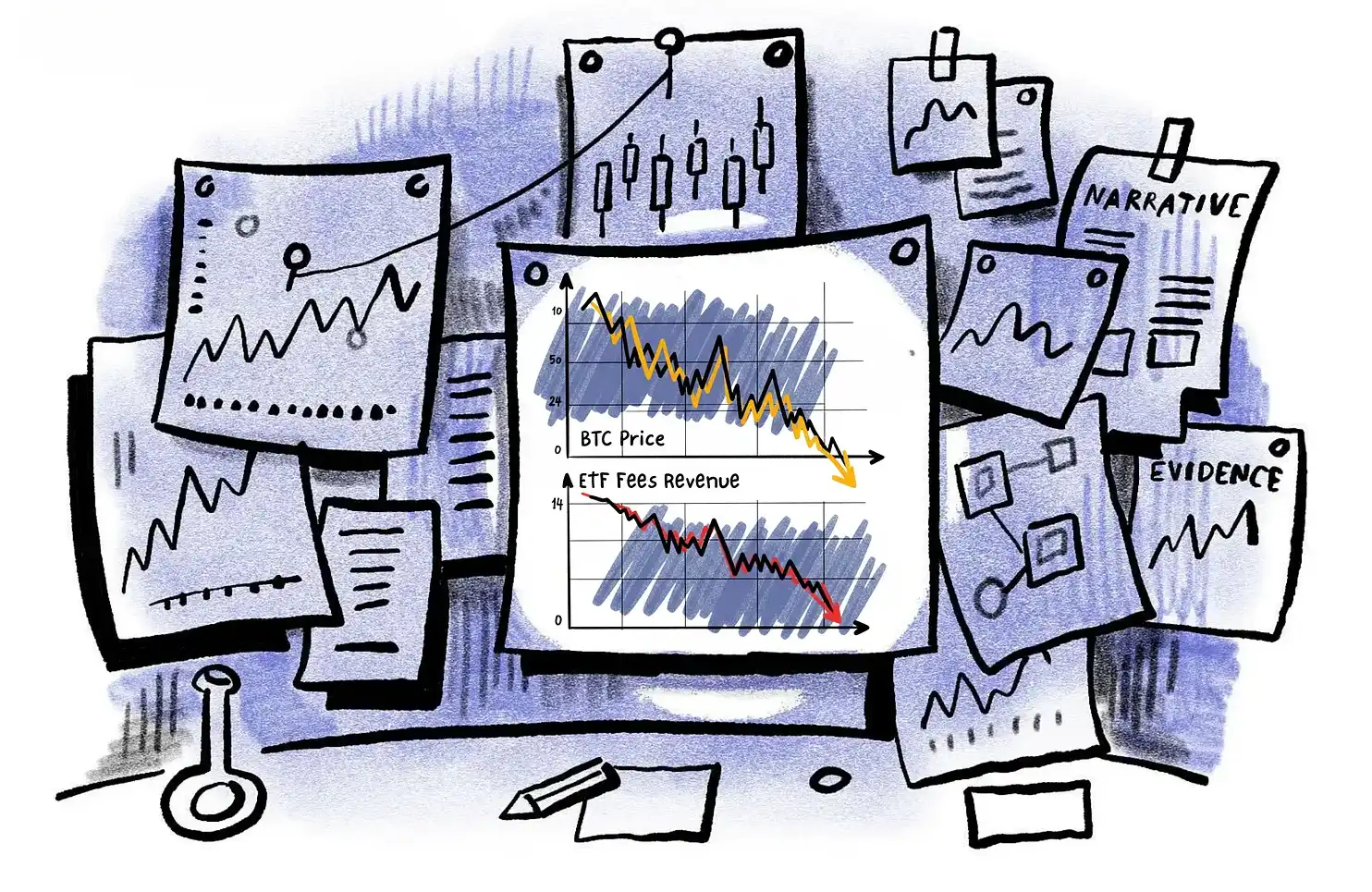
With capital outflows from crypto ETFs, can issuers like BlackRock still make good profits?
BlackRock's crypto ETF fee revenue has dropped by 38%, and its ETF business is struggling to escape the cyclical curse of the market.
Incubator MEETLabs today launched the large-scale 3D fishing blockchain game "DeFishing". As the first blockchain game on the GamingFi platform, it implements a dual-token P2E system with the IDOL token and the platform token GFT.
MEETLabs is an innovative lab focused on blockchain technology and the cryptocurrency sector, and also serves as the incubator for MEET48.






