
Infura launches DIN AVS to bring decentralized RPC and API marketplace to EigenLayer

Quick Take DIN’s EigenLayer AVS aims to bring economic security and decentralization to a traditionally centralized RPC segment. The AVS launch enables permissionless participation from node operators, watchers, and restakers, backed by stETH.
Decentralized Infrastructure Network (DIN), built by the team behind Infura at Consensys, is launching an Autonomous Verifiable Service (AVS) mainnet on EigenLayer, designed to bring economic security and decentralization to a segment long dominated by a handful of centralized remote procedure call (RPC) providers.
The move aims to tackle concentrated RPC infrastructure — the method that wallets, dapps, and platforms use to talk to a blockchain node — which currently funnels 70% to 80% of traffic through a few centralized providers, Infura said in a statement shared with The Block.
EigenLayer enables users to re-stake ETH, including through liquid staking tokens like stETH, to secure third-party applications called AVSs. DIN's AVS represents one of the first large-scale applications of EigenLayer's modular restaking model, with the network structured to scale through participation from hundreds of operators and future onchain incentive mechanisms, according to the team.
"We set out to build a protocol that would finally align incentives across the infrastructure layer of Web3. With EigenLayer, we were able to deliver on that vision by building on a proven restaking standard backed by the strongest asset in crypto: restaked ETH," E.G. Galano, co-founder of Infura, an RPC provider developed by Consensys, said. "DIN's Eigen AVS turns infrastructure into an open marketplace, where reliability and performance are directly rewarded."
DIN, already integrated into MetaMask, Ethereum Layer 2 Linea, and Infura, routes more than 13 billion monthly requests across Ethereum, multiple Layer 2s, and over 20 alternative Layer 1 networks, according to the team. Under the AVS model, node providers earn rewards for uptime and accurate data, and can be slashed over time for downtime or incorrect responses.
"DIN launching on EigenLayer is a major step for crypto infrastructure, because it brings real economic consequences to a part of the stack that's been too easy to overlook," Eigen Labs founder and CEO Sreeram Kannan said. "For years, developers relied on a few centralized RPC providers and had to hope they wouldn't fail."
RPC centralization risk
The Infura team argues that reliance on centralized RPC providers poses systemic risk, as outages can cascade across wallets, dapps, bridges, and DeFi protocols. DIN aims to mitigate this through a decentralized supply of RPC nodes validated by independent watchers and secured by stETH restaking, with ETH and EIGEN support to follow.
Key features include permissionless onboarding for RPC node providers, watchers, and restakers, independent performance verification, and an architecture that lets restakers choose which networks to secure. Infura claimed incentivized testnets recorded a greater than 99% success rate and median latency of under 250ms while serving over 7 billion monthly requests during pilot phases.
Founding node operators, including EverStake, Liquify, NodeFleet, Validation Cloud, and CompareNodes, are already contributing to the AVS mainnet. The DIN team said it has also completed two independent audits, and additional partners supporting the rollout include 0xFury, AltLayer, BlockPi, Chainstack, Compare Nodes, InfStones, Nodies, Northwest Nodes, Rivet, and Simply Staking.
Last month, Axios reported that Consensys had engaged JPMorgan and Goldman Sachs to assist it with an initial public offering in the U.S., following in the footsteps of other crypto-related firms like Circle, Gemini, and Bullish.
Disclaimer: The content of this article solely reflects the author's opinion and does not represent the platform in any capacity. This article is not intended to serve as a reference for making investment decisions.
You may also like
Mars Morning News | Ethereum Fusaka upgrade officially activated; ETH surpasses $3,200
The Ethereum Fusaka upgrade has been activated, enhancing L2 transaction capabilities and reducing fees; BlackRock predicts accelerated institutional adoption of cryptocurrencies; cryptocurrency ETF inflows have reached a 7-week high; Trump nominates crypto-friendly regulatory officials; Malaysia cracks down on illegal Bitcoin mining. Summary generated by Mars AI. The accuracy and completeness of this summary are still undergoing iterative updates.

Do you think stop-losses can save you? Taleb exposes the biggest misconception: all risks are packed into a single blow-up point.
Nassim Nicholas Taleb's latest paper, "Trading With a Stop," challenges traditional views on stop-loss orders, arguing that stop-losses do not reduce risk but instead compress and concentrate risk into fragile breaking points, altering market behavior patterns. Summary generated by Mars AI. The accuracy and completeness of this summary are still being iteratively improved by the Mars AI model.

With capital outflows from crypto ETFs, can issuers like BlackRock still make good profits?
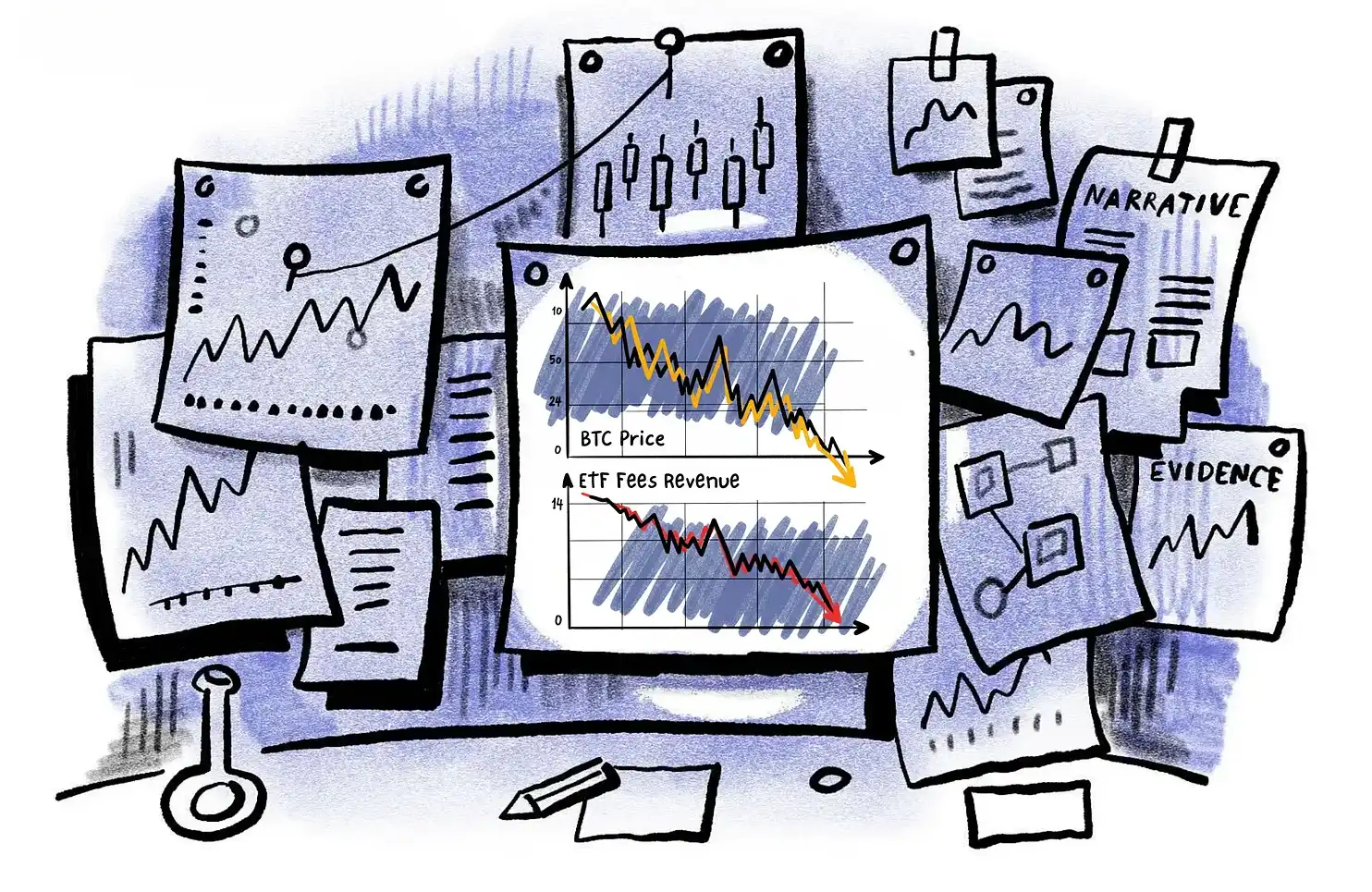
BlackRock's crypto ETF fee revenue has dropped by 38%, and its ETF business is struggling to escape the cyclical curse of the market.
Incubator MEETLabs today launched the large-scale 3D fishing blockchain game "DeFishing". As the first blockchain game on the GamingFi platform, it implements a dual-token P2E system with the IDOL token and the platform token GFT.
MEETLabs is an innovative lab focused on blockchain technology and the cryptocurrency sector, and also serves as the incubator for MEET48.






